Looks like you're located outside the continental United States!
While we can't ship Royal NY Line Up boxes to you through our website, our team of coffee traders will be happy to help place your order and secure the best shipping rates for you.
Please note that if you have other items in your cart such as tea or tickets to an event at The lab, you will not be able to proceed to payment until all 22lb. boxes have been removed from your order
Looks like you're located outside the continental United States!
While we can't ship Royal NY Line Up boxes to you through our website, your coffee trader will be happy to help place your order and secure the best shipping rates for you.
Have you ever baked cookies or roasted vegetables, but had uneven pieces? The small pieces cook fast and start to burn, while the large pieces stay raw in the middle. We can think of this analogy when talking about grind uniformity and coffee brewing.
Coffee Brewing
Brewed coffee is made up of soluble material that we extract from the roasted beans using water. These solubles are things like aromatic compounds, acids, fats, melanoidins and carbohydrates. All of these contribute to the aroma, taste, and texture of coffee. These solubles make up around 30% of a coffee bean. The rest is made up of insoluble carbohydrates, cellulose, and general plant material.
Brewing a delicious cup of coffee requires a game plan. The soluble material in coffee extracts from the grounds at different rates, and not all solubles taste good. There are recommended grind sizes and recipes for each brewing method to help extract just the right amount. Through research dating back to the 1960s by E. E. Lockhart, extracting around 18%-22% of the soluble material from the coffee is usually ideal. We still use Lockhart’s Coffee Brewing Control Chart today as a tool to dial in brewing recipes:
What is Extraction?
Extraction refers to how much soluble material was extracted from the grounds. Strength refers to the amount of soluble material present in the coffee sample, expressed by total dissolved solids or “TDS”.
Back to our cooking analogy: having uniform pieces that cook evenly is similar to having uniform particle sizes that extract evenly. However, because roasted coffee is brittle, it essentially fractures as it’s being ground. Therefore, there is variance in particle sizes, resulting in larger pieces (boulders), and tiny particles that look like coffee dust (fines). The cheaper the grinder is, the more it crushes the coffee beans into random size pieces. This results in an uneven extraction. The fines extract faster, causing bitter flavors we associate with over-extraction. The boulders extract slower, causing sour and sharp flavors we associate with under-extraction.
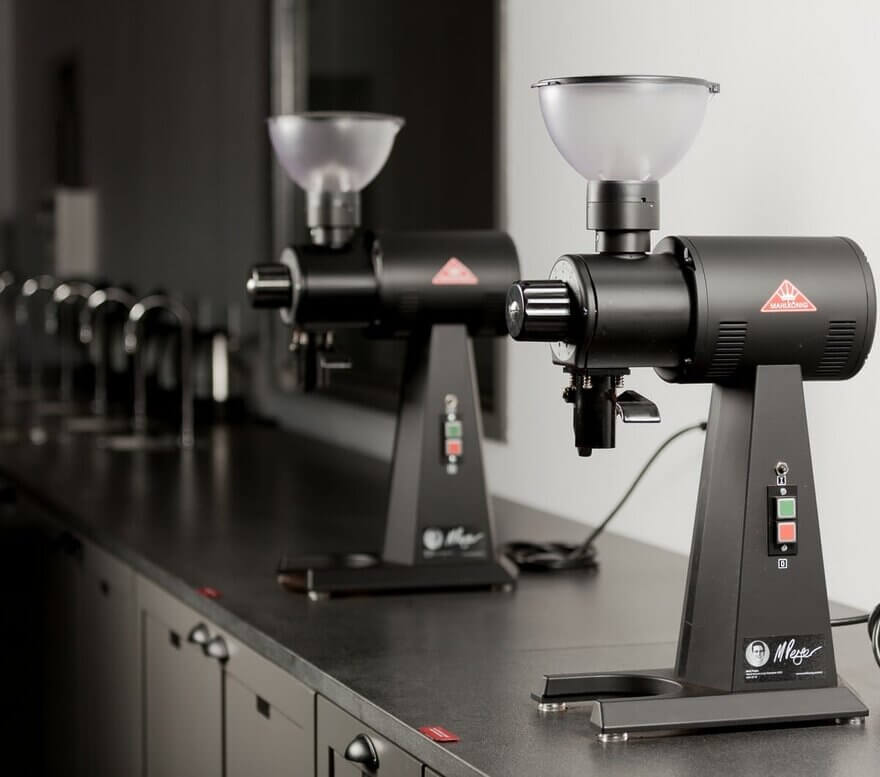
The best way to curb uneven extraction is to use a high-quality burr grinder. It skillfully grinds the coffee into a more uniform particle size, reducing the amount of boulders and fines. The grinder is often overlooked, as people spend more attention on the brewing device. So, you can have the most expensive espresso machine on the market, but if the grinder is cheap, it is basically impossible to pull a balanced shot.
The Kruve Sifter
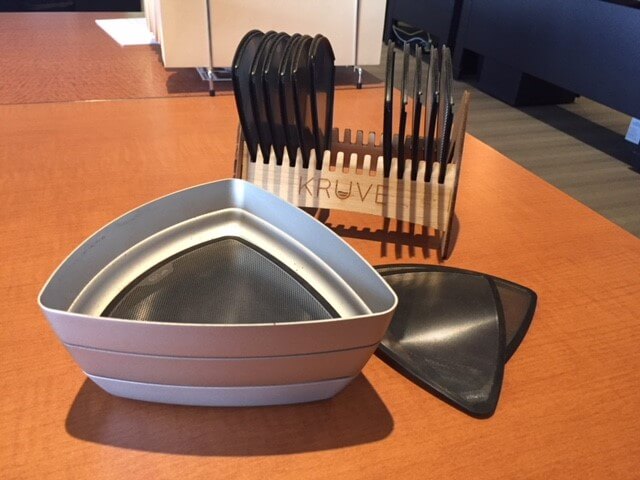
To see how particle size affects the final beverage, we used the Kruve coffee sifter. The Kruve has 2 screens that separate 3 chambers. Screen sizes can adjust depending on the ideal grind size. The screens are measured in microns (µ).
To begin, place all your ground coffee in the top chamber, shake the Kruve for 1:30 minutes, and boom! Boulders stay at the top, the ideal grind size remains in the middle, and fines fall through to the bottom.
Fines on the left, our ideal grind in the center, and boulders on the right.
Our nice, uniform particle size post sifting!
Yes, sifting coffee grounds to separate particle sizes has existed before. However, the Kruve is the first on the market with a reasonable price for coffee shops and home enthusiasts. The Kruve creates a uniform grind size and helps calibrate multiple grinders. Additionally, it finds the right grind size for a brew method (they give recommendations for different brew methods!).
**For both brews we used a 1:16 ratio of 20 grams of coffee and 320 grams of water. We did a 25 gram bloom for 30 seconds, and then did a slow, continuous pour until we hit 320 grams.
The largest difference between the two brews was the sweetness and body. Initially, we tasted Brew 1 and thought it was balanced, but the coffee opened up when tasting Brew 2. The apple note in Brew 1 changed to candy apple in Brew 2. Additionally, the dark chocolate and heavy mouthfeel in Brew 1 mellowed out in Brew 2. Thus, showcasing more of the white sugar sweetness. Overall, Brew 2 had more structured sweetness and flavor clarity.
In conclusion, by removing the fines and boulders to create a uniform particle size, we achieved a more even extraction. This is evident by our SCA score, tasting notes, our TDS reading, and the calculated extraction percentage. ***We still enjoyed Brew 1, and are sure individual coffee drinkers also have their own preferences between the two!
We will be using the Kruve more in the future, so stay tuned! If you are interested in the Kruve for your shop or for yourself, please do not hesitate to reach out to us with any questions: Education@royalny.com.
Notes:
*There are deeper conversations about particle size contribution to a beverage in the coffee industry, which we do not address in this blog post. This blog post introduces why general uniform particle size is important for extraction.
Looks like you're not logged in! If you have an account, log in here
Don't have an account? Click here to register or close popup window and continue shopping.
You successfully reset your password, please login to your account.
This site uses cookies to allow for proper checkout and order processing; they are not used for any other tracking purposes. By continuing, you accept our use of cookies.








 The largest difference between the two brews was the sweetness and body. Initially, we tasted Brew 1 and thought it was balanced, but the coffee opened up when tasting Brew 2. The apple note in Brew 1 changed to candy apple in Brew 2. Additionally, the dark chocolate and heavy mouthfeel in Brew 1 mellowed out in Brew 2. Thus, showcasing more of the white sugar sweetness. Overall, Brew 2 had more structured sweetness and flavor clarity.