Looks like you're located outside the continental United States!
While we can't ship Royal NY Line Up boxes to you through our website, our team of coffee traders will be happy to help place your order and secure the best shipping rates for you.
Please note that if you have other items in your cart such as tea or tickets to an event at The lab, you will not be able to proceed to payment until all 22lb. boxes have been removed from your order
Looks like you're located outside the continental United States!
While we can't ship Royal NY Line Up boxes to you through our website, your coffee trader will be happy to help place your order and secure the best shipping rates for you.
To celebrate Royal Tea New York’s 10th anniversary, we wanted to take a memorable journey to origin. In part one of our Japan recap, explore Shizuoka with us as we visit organic tea farms, tour matcha factories, meet producers, and more!
Why Going to Origin Matters
When planning this trip, our goal was to visit some of our most trusted producers and strengthen our relationships with them. These connections are an important part of our mission: bringing you quality tea at an affordable cost.
Meeting the farmers, putting faces to names, and showing appreciation for what they do is always a heartwarming experience. This is true no matter how many times we do it.
Arriving in Shizuoka, Japan’s Green Tea Capital
Our first stop on our trip to Japan was Shizuoka. While we were off to a rocky start (those who heard about the Amtrak fiber optics fiasco on the news will know what I’m talking about), we still made it to Tokyo with only a small delay after a flight cancellation. Traveling always comes with surprises, unfortunately.
Shizuoka was a quick Shinkansen (bullet train) ride away from Tokyo, taking only an hour and a half. After arriving in Tokyo, we hopped on and reached Shizuoka by late evening. The region is one of Japan’s most widely recognized tea-producing prefectures. It also accounts for around 40% of Japan’s overall green tea production.
In fact, 2026 saw Shizuoka overtake Kagoshima and reclaim its spot as Japan’s leading green tea producer for the first time in two years. Aracha tea production exceeded 10,000 tons, a 32% increase over last year. Favorable weather and an increase in overall demand helped drive the growth, particularly as the matcha boom surges onward. Clearly, Shizuoka tea remains an important part of Japan’s green tea industry.
Osada Seicha
Our primary reason for traveling to Shizuoka was to visit our friends at Osada Seicha. We’ve been buying matcha, hojicha, and other green teas from them for the last three years. They continue to prove themselves as a reliable and valued partner.
Visiting the Tea Farms in Isagawa
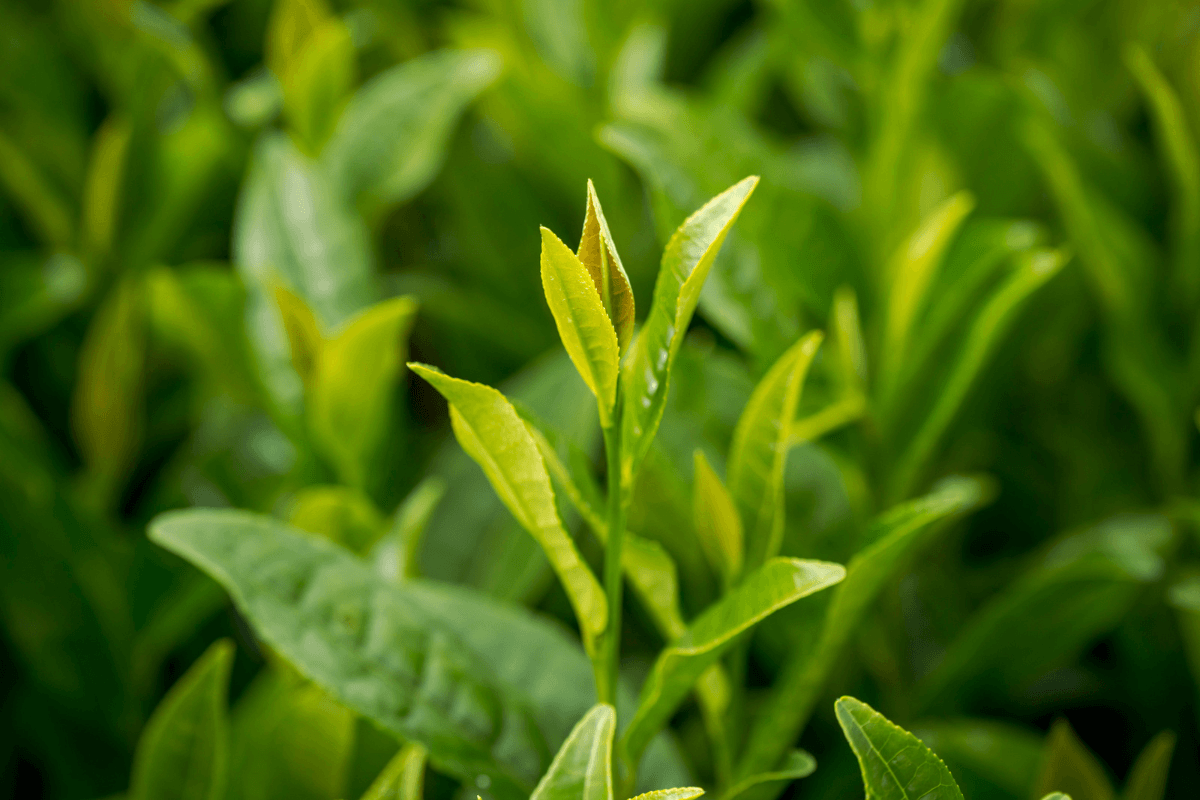
Yugo, our friend from Osada Seicha, picked us up bright and early at our hotel. Our first stop of the day was to visit one of the farmers we work with, whose farm was located high up in the mountains of Isagawa in the Haruno district. Situated at about 400masl, the area is perfect for tea cultivation. The soil is rich with minerals, and the climate is deal. This is especially true for the frost-resistant Yabukita cultivar, although farmers harvest others here as well.
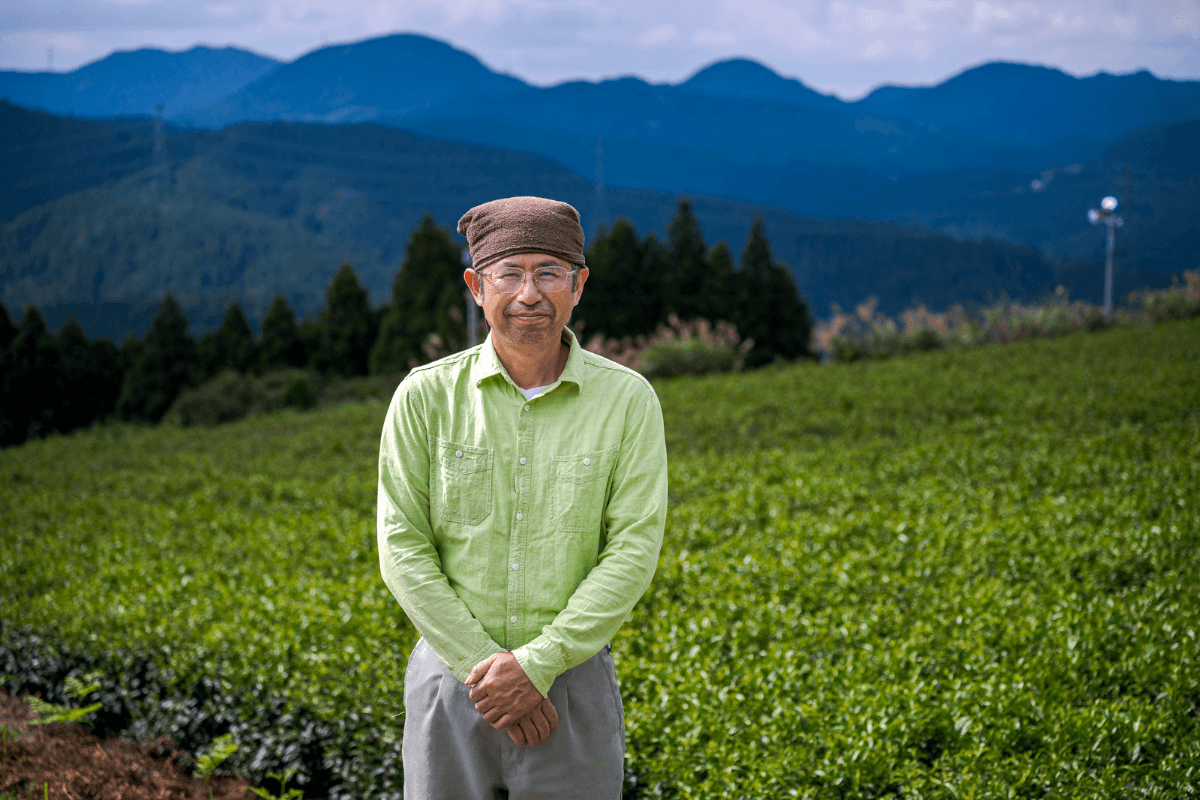
Mr. Suzuki, a fifth-generation tea farmer in Isagawa, Japan.
While we were there, the sun was out, which was a welcome surprise. We’d just narrowly avoided the typhoon that hit the region a few days earlier. However, it was humid, and it didn’t take long to overheat while standing in the sun. As we admired the rows of carefully planted tea bushes, Mr. Suzuki appeared, smiling and eager to show us his work.
Mr. Suzuki is a fifth-generation tea farmer with a passion for organic farming, although he’s one of many farmers in Isagawa. Several families own land here, and they work in tandem to produce organic tea.
This year, we purchased Mr. Suzuki’s Organic Matcha Tsuyuhikari. Tsuyuhikari is a rare cultivar, a cross between Asatsuyu and Shizu-7132. It’s a limited tea, but a special one, with standout notes of rice milk, brown sugar, and steamed greens.
He showed us other cultivars as well, including Benifuuki, Yabukita, and Saemidori. When asked what his typical day in the garden looked like, Mr. Suzuki laughed. He gave a short and sweet answer, saying, “I wake up, I check the bushes, and then I go home.”
As we visited right before third flush tea was ready to be harvested, his response made sense. In the following weeks, his days would be much more eventful!
Touring the Osada Seicha Factories
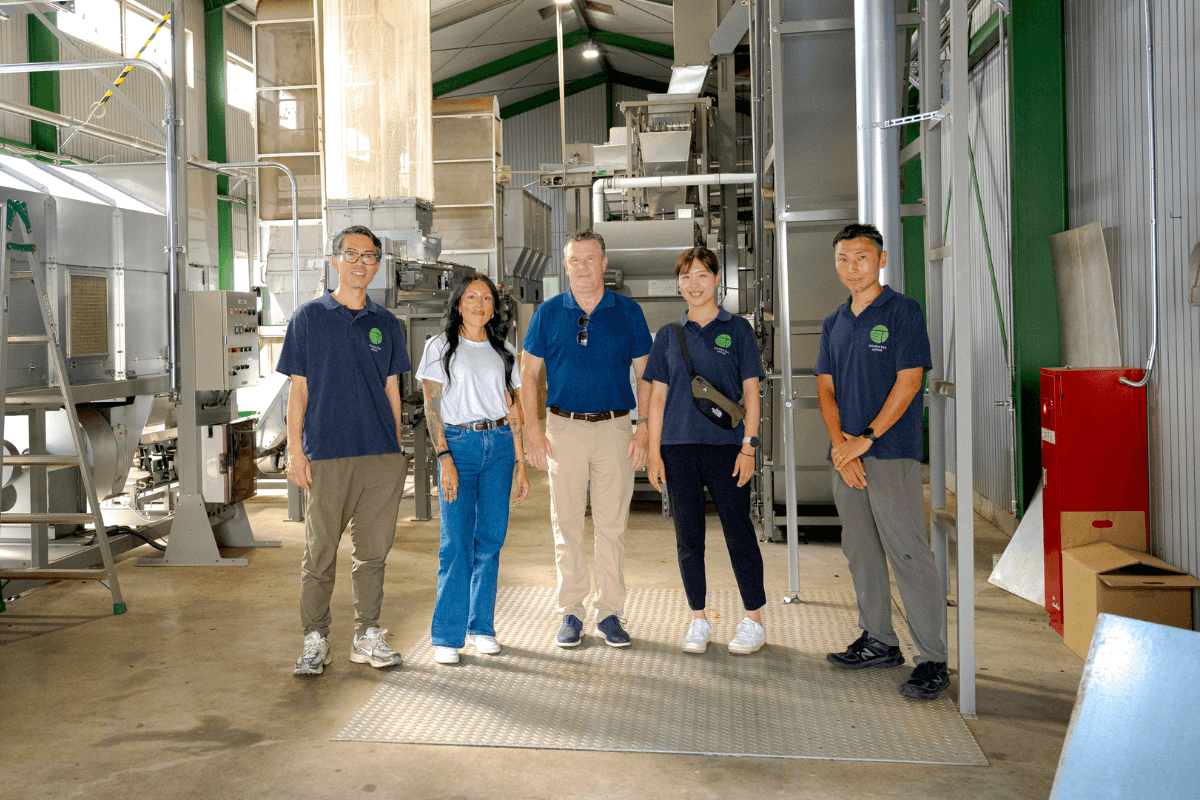
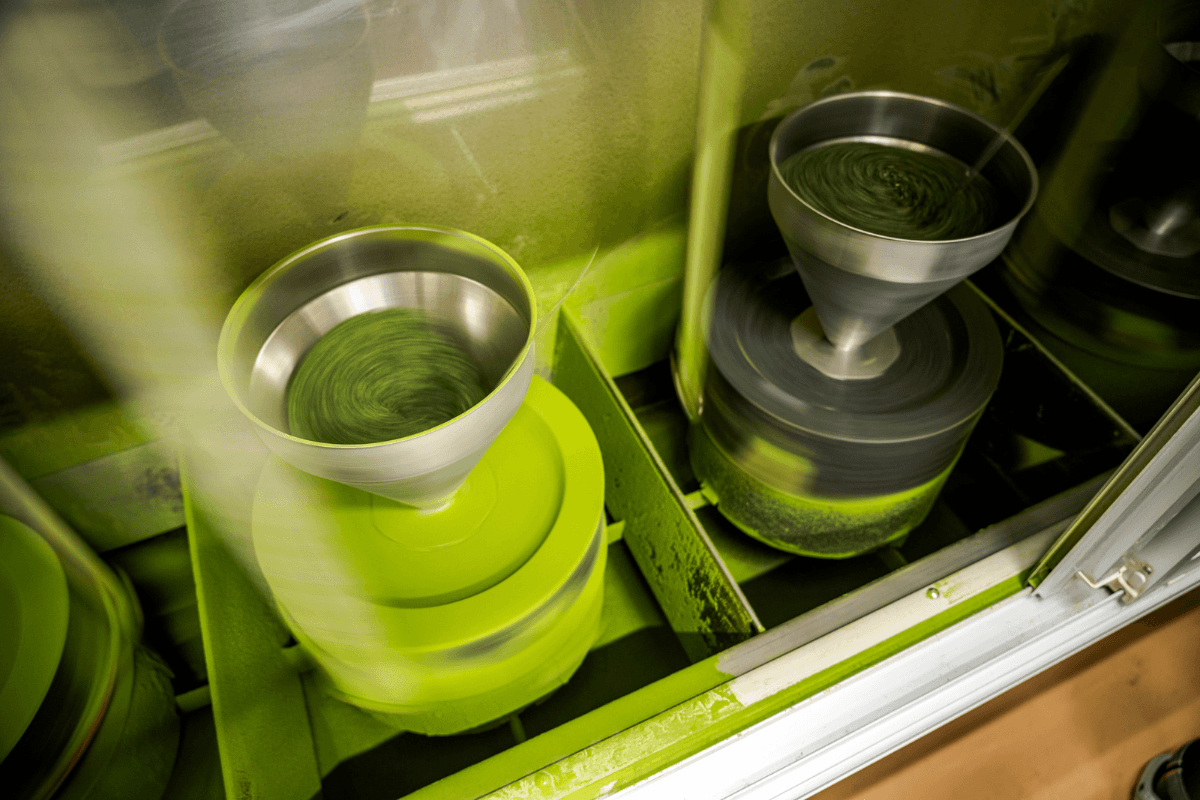
Once we had our fill of fresh mountain air, we wrapped up at Isagawa and headed to Osada Seicha’s HQ. After a quick sencha break, Yugo showed us around their aracha factory, which was attached to their main office. They also kept their stone mills there, which spun behind glass doors, steadily grinding tencha at a rate of less than 40g an hour.
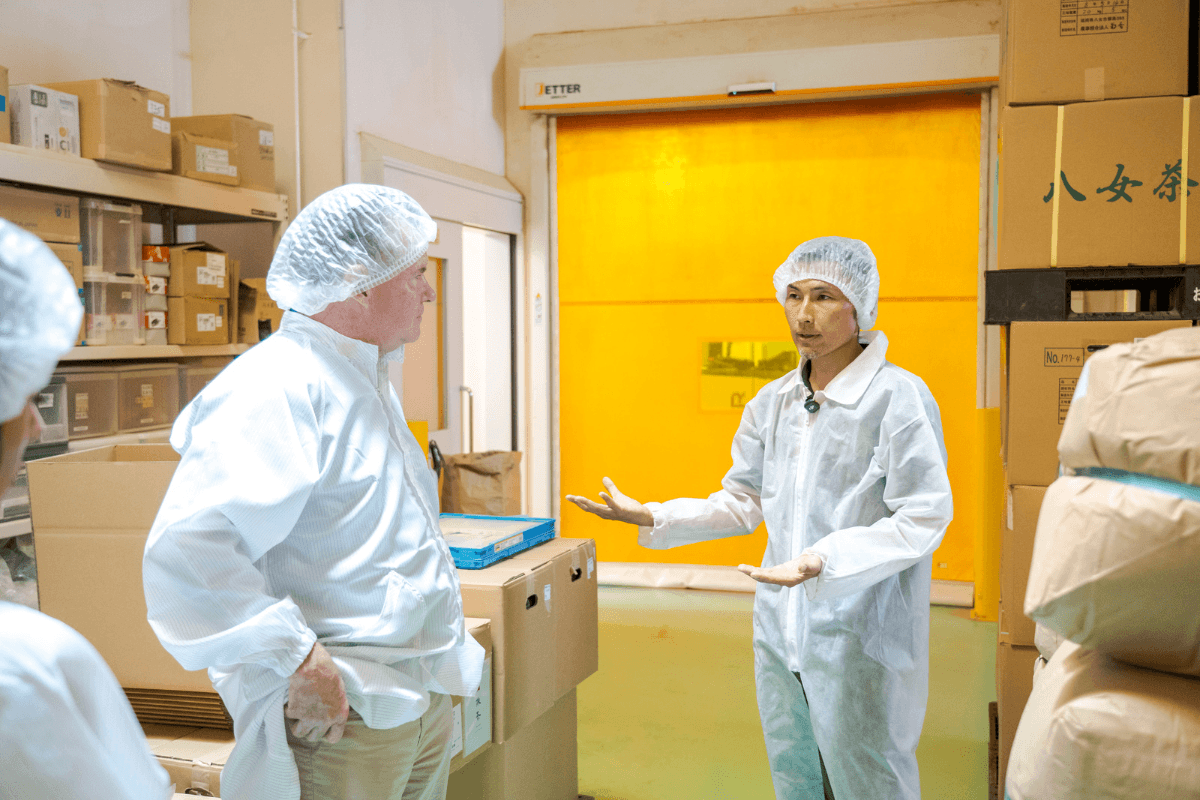
Yugo walked us through the complexities of all the machinery, which was truly impressive. We also saw bead mills, which are more modernized machines used for grinding tencha, yielding much more per day than the traditional stone mill.
Yugo leading Team RTNY on a tour of Osada Seicha’s factory.
After touring factory number one, we paused for a lunch break and met Natsumi-san, Osada Seicha’s president. Natsumi-san is a third-generation tea professional, as well as an award-winning, eighth-dan-certified tea appraiser. He took us to a local country club restaurant, where we chatted over sushi and swapped pictures of our pet Shiba Inus.
Next, we traveled to Osada’s brand-new tencha factory. Tea plants surrounded the property, which added to the ambience. Natsumi-san and Yugo took us through the building, where all the machinery still looked shiny and new. The factory was quiet as third harvest production hadn’t begun, but it was still a sight to behold.
Visiting Osada’s Tea Café
We made a quick stop at Osada’s tea café, spearheaded by Natsumi-san’s wife, Kaori-san. She welcomed us warmly and served us some cold strawberry tea. Interestingly enough, it wasn’t flavored, yet the bright fruit notes clearly shone through.
There were many teas for sale, all produced by Osada and their partners. Patrons were busy drinking tea, accompanied with sweets like ice cream, pastries, and jelies.
Cupping Fresh Japanese Teas
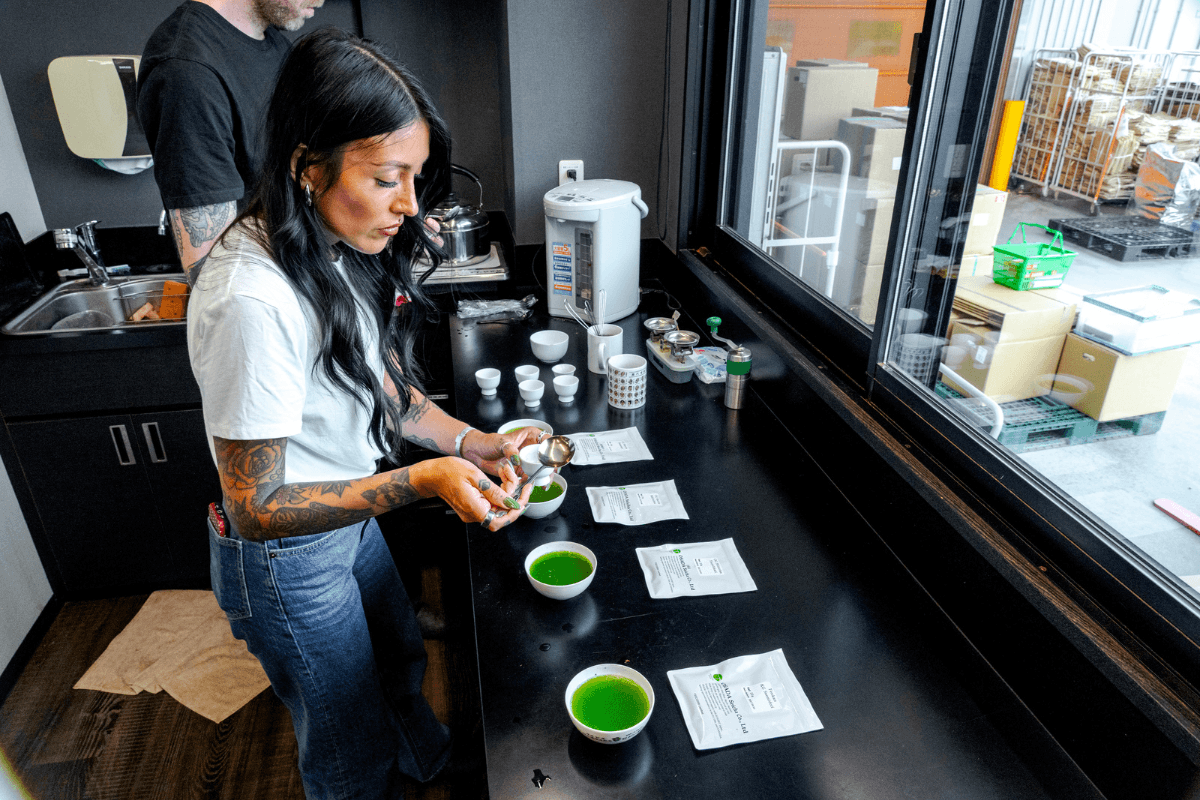
We soon returned to Osada Seicha’s HQ, where we cupped from fresh teas, including this year’s Organic Matcha Kakitsubata. Natsumi-san proudly explained that the quality was somehow even better than last year’s. That was hard to imagine, given the popularity of previous harvests!
He also prepared a sample of Mr. Suzuki’s Tsuyuhikari matcha, my personal favorite. The matcha was an umami bomb, one that Jaime and Mike enjoyed as well.
We also tried some fun black teas: a Tsuyuhikari, a Benifuuki first flush, and a Hatsumomiji. Natsumi-san also shared his award-winning “Yamabuki Nadeshiko,” a tea fermented with kuroki, a mold that produces citric acid and is commonly used for shochu. It had a delicious fruity flavor, and we learned it was what we actually tasted at the café!
Team RTNY cupping different teas at Osada Seicha’s HQ.
What’s Next for Osada Seicha?
As we wrapped up our visit, we discussed the future of Osada Seicha. Natsumi-san mentioned building another factory on the plot next to their HQ and took us to the site. There wasn’t much to see yet, but they hope to complete it by the end of 2027. Plus, they plan to purchase even more stone mills to keep up with demand.
Natsumi-san also hoped that the West would learn to appreciate more Japanese teas as much as matcha. There are many other teas from Japan that deserve a chance in the spotlight, and we hope to introduce more of them to you over time.
Experiencing a Traditional Japanese Tea Ceremony
After saying goodbye to Natsumi-san, Yugo took us to our last stop of the day: a traditional tea ceremony, or chado.
We arrived at Ninomaru Teahouse, situated within the grounds of Kakegawa Castle. As we made our way to the tearoom, we enjoyed the gardens surrounding the one-story building.
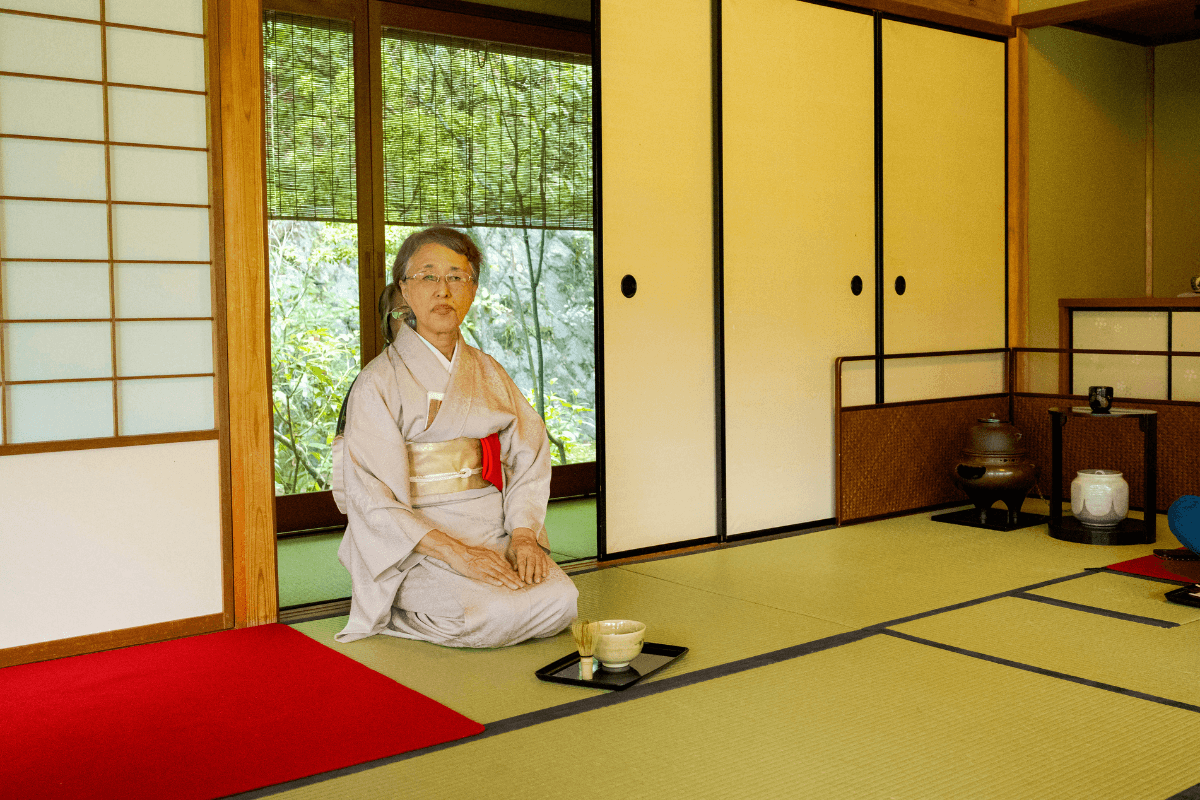
The entrance to the tearoom, called nijirigushi, was slung low, forcing guests to crawl inside as a symbol of humility. During the samurai era, soldiers had to leave their swords outside before participating as tea ceremony was neutral ground. All participants were treated as equals, regardless of rank or social standing.
Preparing and Enjoying Matcha
The room was carpeted in traditional tatami mats, and we sat on the floor as we greeted our hosts, who were dressed in kimonos and obi sashes. They prepared individual trays for us, each having a chawan (bowl used to prepare matcha) and beautiful wagashi (Japanese confection).
Our hosts bowed as they passed out our trays, and as we received them, we bowed back. We were instructed to eat the wagashi before preparing our matcha, as it was meant to balance out the strong flavor of the tea. We took a quiet moment to appreciate the treat—it was rich, with a mochi-like texture.
Tea ceremony tray with a chawan, chasen, and wagashi.
Then, our hosts helped our group prepare usucha (“thin tea”) using our chasens (bamboo whisks). My coffee counterparts struggled with this part, and it was hard not to laugh!
Once we all managed to whisk satisfactorily, we drank. As instructed, we turned the bowls in our hands as we sipped, which allowed us to admire the individual designs. Thankfully, slurping isn’t viewed as rude, but appreciative. This was great news since we’re all Professional Slurpers.
The Importance of Tea Ceremony
Experiencing the roots of matcha through tea ceremony was invaluable. Everything had significance, from the gardens we crossed to reach the tearoom to the scroll on the wall, which could represent the theme of the ceremony.
In the West, we’re more familiar with the matcha latte, typically enjoying a drink in a to go cup. In tea ceremony, you’re encouraged to slow down, be mindful, and be intentional. It’s a time to be present, as well as show gratitude and appreciation. Moments like those are often hard to come by in the modern world.
Looking Back on Our Shizuoka Tea Visit
We bowed to our host once more before saying our goodbyes. Yugo dropped us off at our hotel just as the sun had set. While our time in Shizuoka had come to a close, the journey was far from over.
Team RTNY touring Osada Seicha’s new tencha tea factory in Shizuoka, Japan.
Not long after, our coffee traders embarked on the second part of their journey to Indonesia, where they connected with producers in Sumatra and Bali. Meanwhile, I spent more time in Japan and traveled to Kagoshima, another prominent area for green tea production.
Our time in Shizuoka gave us a closer look at the people, places, and traditions behind the teas we source. Most importantly, it reminded us of the relationships that make our work possible.
Stay tuned for Journey to Japan Part 2: Kagoshima.
Looks like you're not logged in! If you have an account, log in here
Don't have an account? Click here to register or close popup window and continue shopping.
You successfully reset your password, please login to your account.
This site uses cookies to allow for proper checkout and order processing; they are not used for any other tracking purposes. By continuing, you accept our use of cookies.