Looks like you're located outside the continental United States!
While we can't ship Royal NY Line Up boxes to you through our website, our team of coffee traders will be happy to help place your order and secure the best shipping rates for you.
Please note that if you have other items in your cart such as tea or tickets to an event at The lab, you will not be able to proceed to payment until all 22lb. boxes have been removed from your order
Looks like you're located outside the continental United States!
While we can't ship Royal NY Line Up boxes to you through our website, your coffee trader will be happy to help place your order and secure the best shipping rates for you.
Indonesian coffee stands out for its distinctive flavor profiles, traditional processing methods, and strong ties to the communities that produce it. During a recent origin trip, the Royal New York team traveled through Sumatra and Bali to visit longtime partners, explore coffee farms and processing facilities, and learn more about the traditions and challenges shaping coffee production throughout Indonesia.
A Journey through Indonesian Coffee
In late September, we traveled to Indonesia to visit longtime partners, explore coffee farms and processing facilities, and gain a better understanding of the challenges facing producers throughout the country. For Jaime and me, this was part two of Royal New York’s first combined Tea/Coffee origin trip, which began in Japan in late September. Senior Tea Trader, Caitlin Schiessl, will recap our journey through Japan in the coming weeks.
Our travels took us from the warehouses of Medan into the Gayo Highlands of northern Sumatra, before finishing our journey in Bali. This was my first visit to Indonesia, Jaime’s fourth, and I was excited to experience the country. Traveling to northern Sumatra was something we could hardly have imagined doing just a year ago. Following the devastating tropical cyclone that struck the region late last year, communities throughout the north have faced unimaginable challenges. Roads and bridges were destroyed, homes were lost, and the infrastructure supporting the movement of coffee throughout the region was severely damaged.
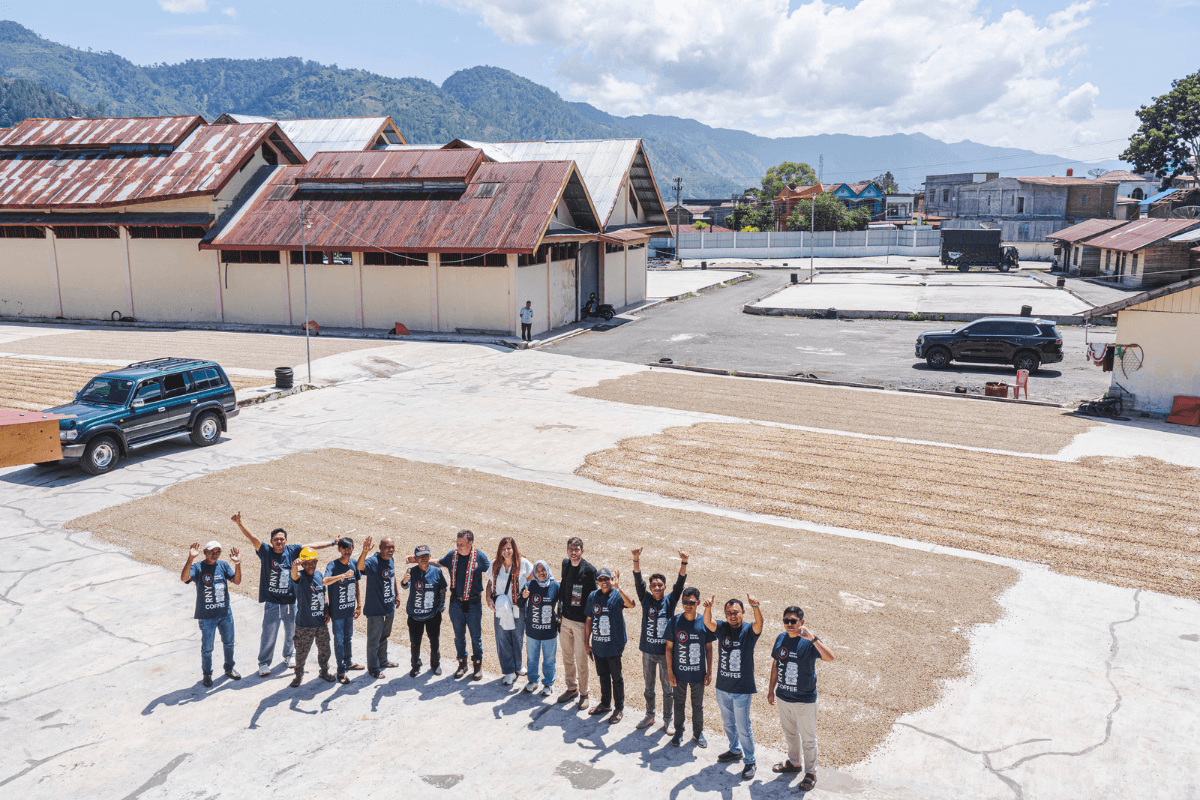
Team IKA and Royal New York
Upon arriving in Medan, the first thing that caught us by surprise was the smell of smoke in the air. Wildfires are continuing to affect parts of Indonesia, creating concerns about air quality throughout the region. Traffic in Medan seemed to move in every direction at once, and that, the smoke, and heat, all made for an eye-opening introduction to Indonesia.
Despite these conditions, what stood out most throughout our whole visit was the warmth and generosity of the people we met. Everywhere we went, we were welcomed with open arms, big smiles, and a level of hospitality that was difficult to put into words.
Behind the Scenes of Sumatran Coffee
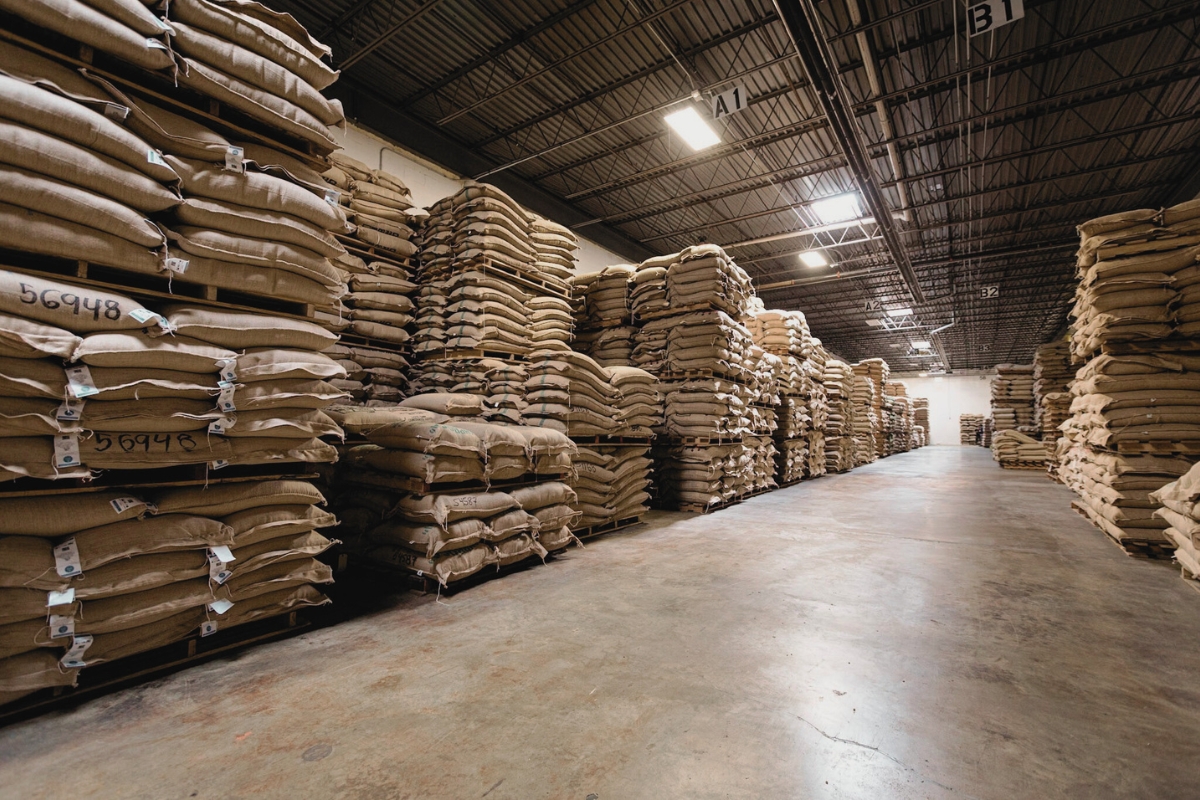
We started our trip visiting mills in Medan and eventually traveling north to Takengon. Each stop offered a different perspective on the work that goes into preparing coffee for export, and it was encouraging to see the level of care and pride shared by our partners.
Team PTSMG and Royal New York
Understanding Sumatra’s Wet-Hulling Process
Sumatra is best known for its traditional wet-hulling process, locally called giling basah. Unlike many washed coffees, which are fully dried in their parchment before hulling, wet-hulled coffees have their parchment removed while the beans still contain a relatively high level of moisture of around 40%. The coffee is picked, pulped, partially dried, then hulled in the north and then undergoes additional drying before being prepared for export down south in Medan.
This unique method reflects the region’s growing conditions and contributes to the characteristics often associated with Sumatran coffees, including a heavy body and notes of dark chocolate, molasses, and cedar. Seeing this process firsthand gave me a greater appreciation for what makes these coffees so different. If every coffee tasted the same, there wouldn’t be much to get excited about. Indonesian coffees have their own identity, shaped by the environment, traditions, and processing methods that make them stand out.
We also wanted to learn more about how producers prepare and sort coffee before shipment. Across the facilities we visited, we observed a combination of traditional hand sorting and newer optical color sorting technologies. Both methods help prepare coffee for export and uniquely ensure it meets quality standards.
Hand sorting remains an important part of coffee production throughout much of the world, including Africa, Central America, and South America. As we’ve seen at other origins, women make up a significant portion of the sorting workforce in Sumatra as well. Their experience and attention to detail are important parts of the preparation process.
Seeing these different approaches firsthand gave us continued appreciation for the amount of work involved in preparing green coffee.
The Gayo Highlands: A Road to Recovery
From Medan, our travels took us north toward the Gayo Highlands, where we visited farms, cooperatives, and mills throughout the region. Getting there proved to be an experience in itself to say the least. We expected to make the journey in a roughly two-hour flight, but instead, we spent nearly 13 hours making our way from Medan to Takengon by road.
Although it was a long day, I found the journey fascinating. The country through a car window was beautiful, with rice farms scattered throughout the passing scenery and the views of communities working to regain some sense of normalcy. There were still signs of disrepair following last year’s storm, but there were also plenty of signs of people rebuilding and going about their daily lives as best they could.
The Impact of the Cyclone on Gayo Coffee Communities
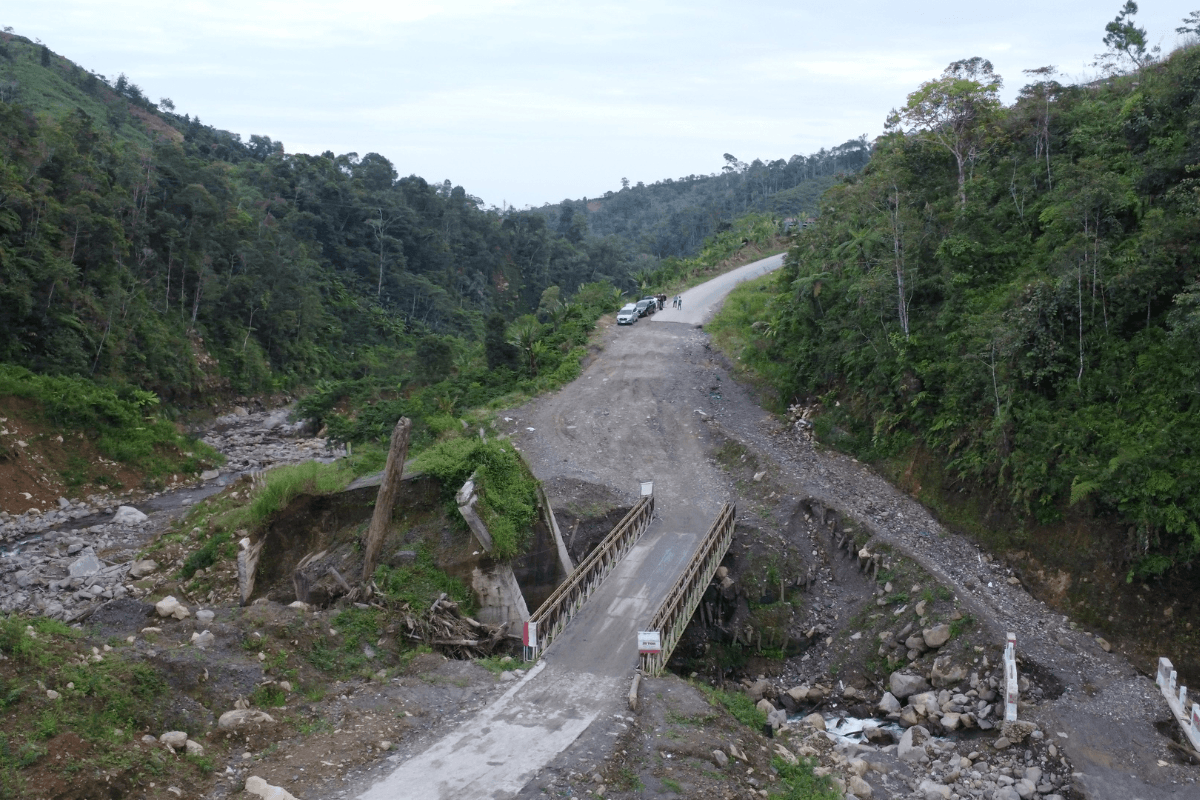
As we traveled north, the lasting effects of the cyclone became increasingly apparent. Roadways remained heavily damaged, temporary bridges were still in place, and communities were continuing to rebuild. One of the most striking moments came as we traveled through Kuala Simpang. We spent some time near a bridge spanning a muddy river, where local residents were selling fish and going about their daily lives. We learned from locals that during the flooding, people had sought refuge on the bridge because it was one of the highest points they could get to. Looking at the surrounding buildings, we could see waterlines reaching just below the second-story windows.
It’s hard not to be awestruck when imagining the sheer power of nature and how quickly it can reclaim its land. The thought of people seeking refuge on a bridge, with rising water surrounding them, was especially difficult to comprehend. Despite the extensive damage, life was moving forward. The fact that all of this damage came from a 6-hour storm is remarkable.
Before the cyclone, moving coffee from the northern growing regions toward Medan typically required approximately 15 hours using a single truck. Today, damaged roadways and temporary bridges have forced exporters to rely on two smaller trucks to move the same volume, with each journey now taking upwards of 24 hours. With fuel costs remaining high and transportation schedules increasingly difficult to coordinate, moving coffee through the region has become considerably more complicated. The fact that these coffees continue to make their way from remote farms in the mountains to roasters around the world is incredible.
Tradition and Quality in Indonesian Coffee
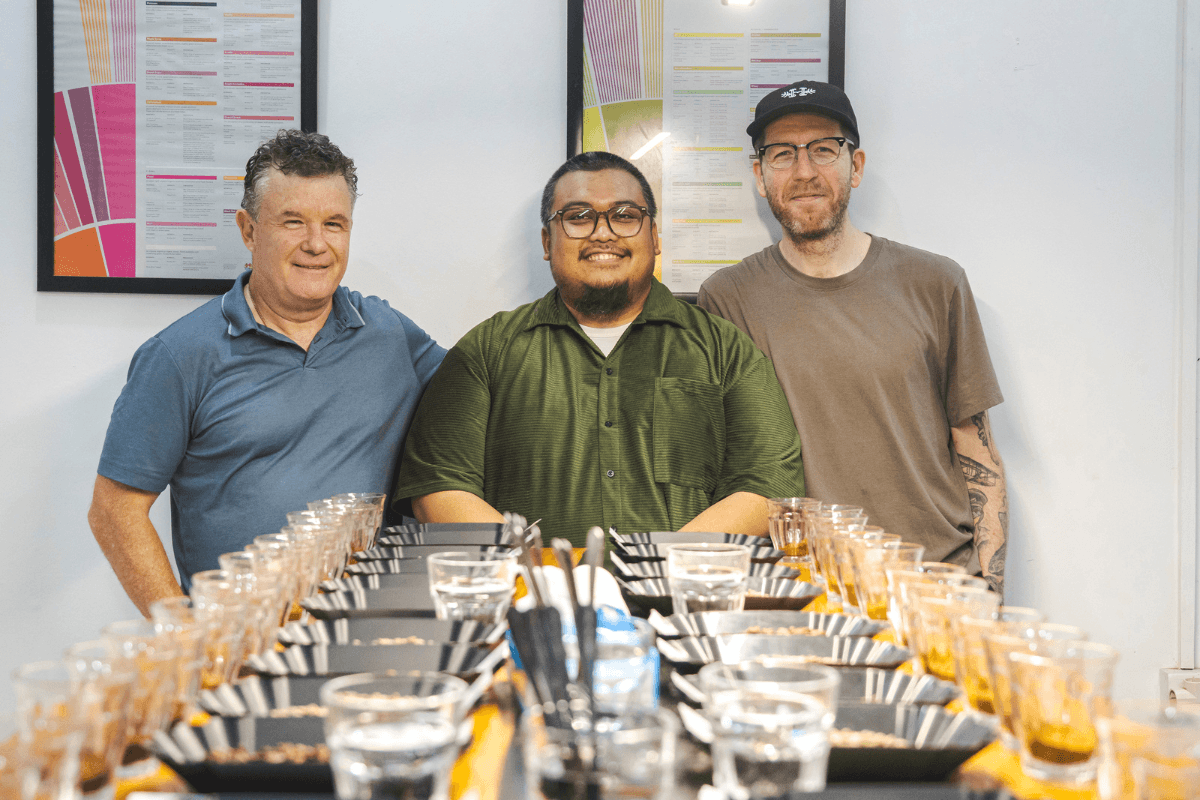
Jaime, Dhani, and Mike at Indokom
Of course, no origin trip would be complete without spending time at the cupping table. Throughout Sumatra, many of the coffees we tasted reflected the familiar profiles we’ve come to expect from the region, with plenty of dark chocolate, molasses, and cedar. These characteristics are a big part of what makes Indonesian coffee so recognizable, but we also had the opportunity to experience coffees that offered a different perspective on the region’s versatility.
Alongside traditional wet-hulled coffees, we tasted offerings produced through more selective cherry harvesting and experimental fermentation methods. Some presented brighter acidity, more pronounced fruit characteristics, and additional complexity which we were pleasantly surprised by. It was interesting to see such a broad range of profiles while learning more about the processing methods and decisions behind each coffee.
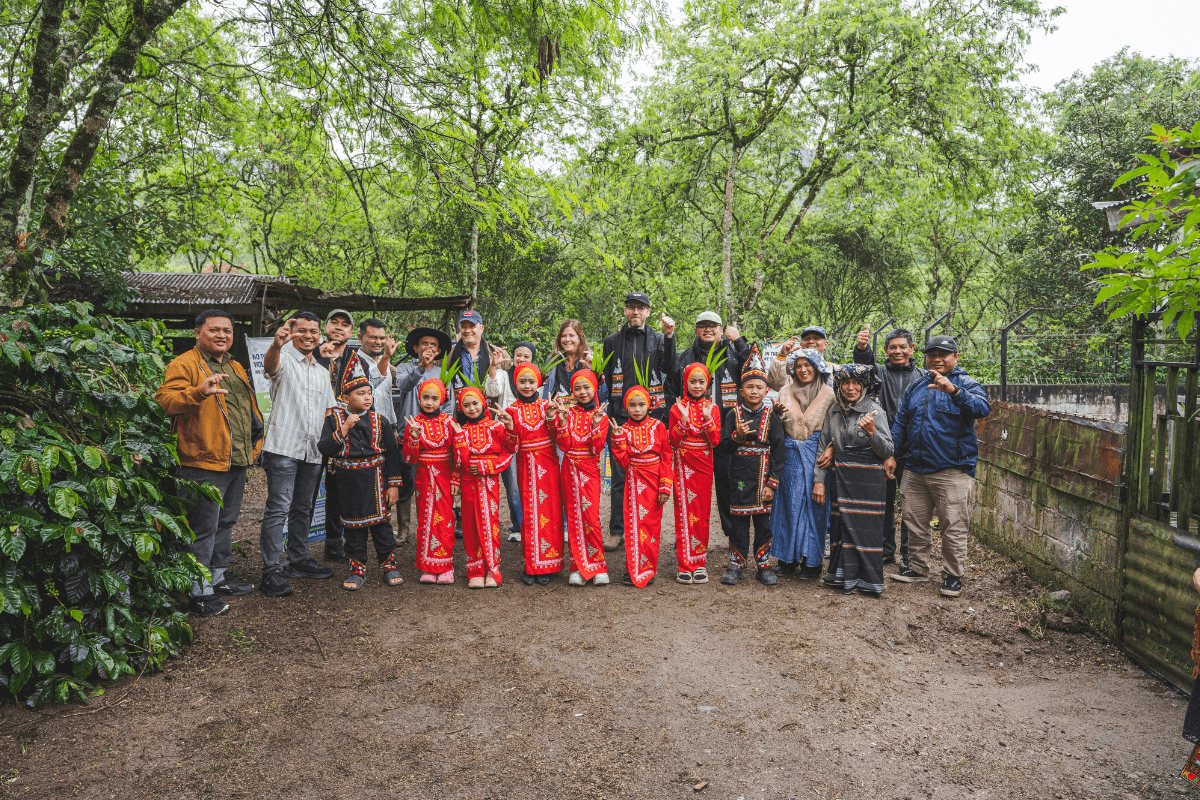
More importantly, spending time with the people responsible for growing, processing, and preparing these coffees gave us a continued understanding of the work involved before a single bag ever reaches our warehouses. At nearly every stop, we were welcomed by cooperative managers, producers, and their families. Even on the opposite side of the world, there were moments when we felt completely at home.
Bali: Another Side of Indonesian Coffee
After a week in Sumatra, we traveled to Bali to explore another one of Indonesia’s coffee-growing regions. Bali had a noticeably different feel from Sumatra, and its coastal communities, bustling tourism industry, and greater Western influence made parts of the island feel more familiar to us.
While there were similarities between the growing environments, one of the most noticeable differences was the proximity of farms to the coast and export facilities. In Bali, coffee travels from farm to port in approximately two hours, while shipments from Sumatra can require much longer road journeys. Considering the transportation challenges we had just witnessed in the north, this difference was particularly striking.
We spent time exploring beautiful farms in the Kintamani region and learning more about local production and processing methods. Many of the coffees we tasted shared familiar characteristics with traditional Indonesian profiles, although several presented a cleaner cup with a pleasant toasted marshmallow finish.
One interesting takeaway was how dramatically domestic consumption has increased since the pandemic across both Bali and Sumatra, according to the people we spoke with. We learned that many of Indonesia’s more experimental coffees are staying in the domestic market, where local roasters and consumers are increasingly embracing them.
More Than Coffee: The People Behind Indonesian Coffee
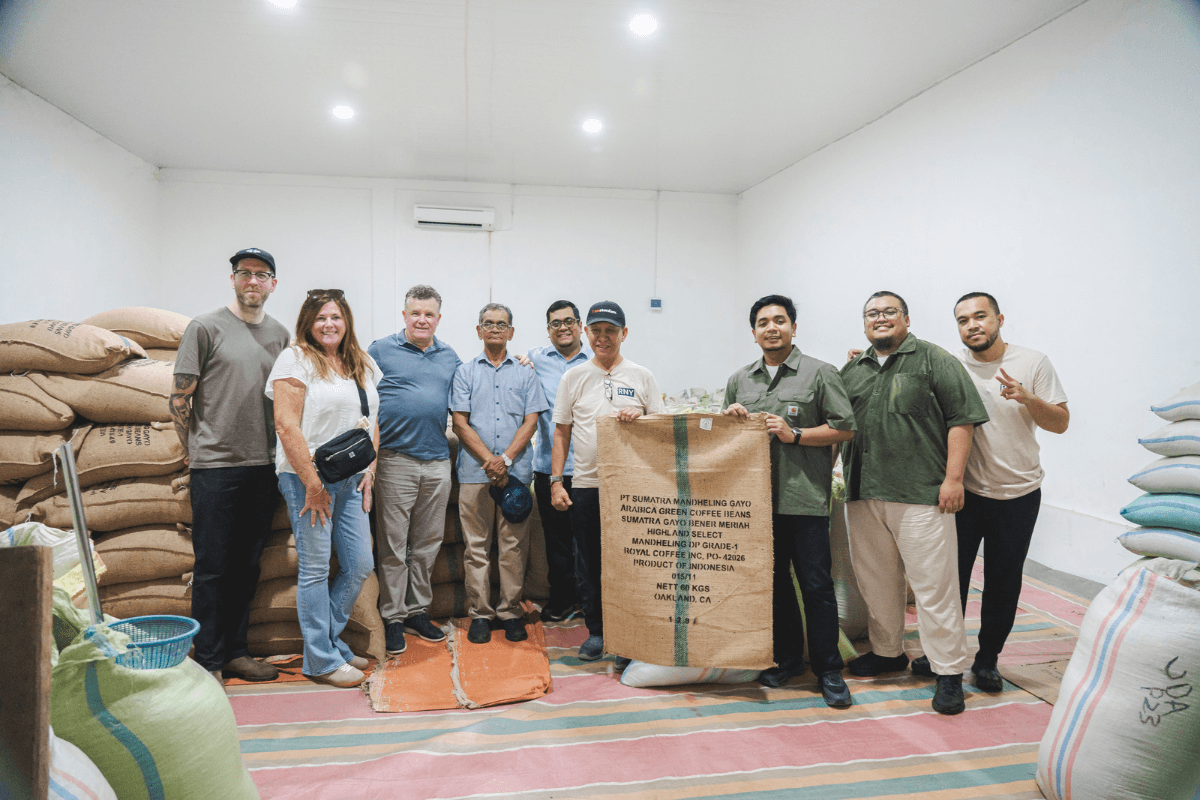
Team Indokom and Royal New York
Indonesian coffees have been an integral part of Royal Coffee New York’s business since the very beginning. Trips like this give us the opportunity to strengthen relationships and better understand the challenges our partners face. For me personally, origin trips have always provided a sense of rejuvenation and a renewed appreciation for the industry we’re fortunate enough to be a part of.
When we consider the damage caused by last year’s storm and the transportation challenges that remain, the fact that coffee continues to move out of northern Sumatra is nothing short of a miracle. The recovery is far from over, and the challenges facing producers remain very real. But throughout our visit, we saw an unwavering sense of pride, generosity, and determination among the people we met.
To all of our partners who welcomed us into their mills, farms, and homes, thank you. Your hospitality and resilience left a lasting impression on us. We are grateful for the relationships we’ve built together and look forward to continuing that work for many years to come.
Looks like you're not logged in! If you have an account, log in here
Don't have an account? Click here to register or close popup window and continue shopping.
You successfully reset your password, please login to your account.
This site uses cookies to allow for proper checkout and order processing; they are not used for any other tracking purposes. By continuing, you accept our use of cookies.