Looks like you're located outside the continental United States!
While we can't ship Royal NY Line Up boxes to you through our website, our team of coffee traders will be happy to help place your order and secure the best shipping rates for you.
Please note that if you have other items in your cart such as tea or tickets to an event at The lab, you will not be able to proceed to payment until all 22lb. boxes have been removed from your order
Looks like you're located outside the continental United States!
While we can't ship Royal NY Line Up boxes to you through our website, your coffee trader will be happy to help place your order and secure the best shipping rates for you.
To celebrate Royal Tea New York’s 10th anniversary, we wanted to take a memorable journey to origin. In part one of our Japan recap, we explored Shizuoka. In part two, we’ll cover visiting family-run farms, sampling unique cultivars, and discovering local traditions in Kagoshima.
Arriving in Kagoshima
After wrapping up in Shizuoka, it was finally time to get back on a plane. The rest of the team was heading off on their Indonesia coffee adventures, but I hopped on a quick flight to Kagoshima.
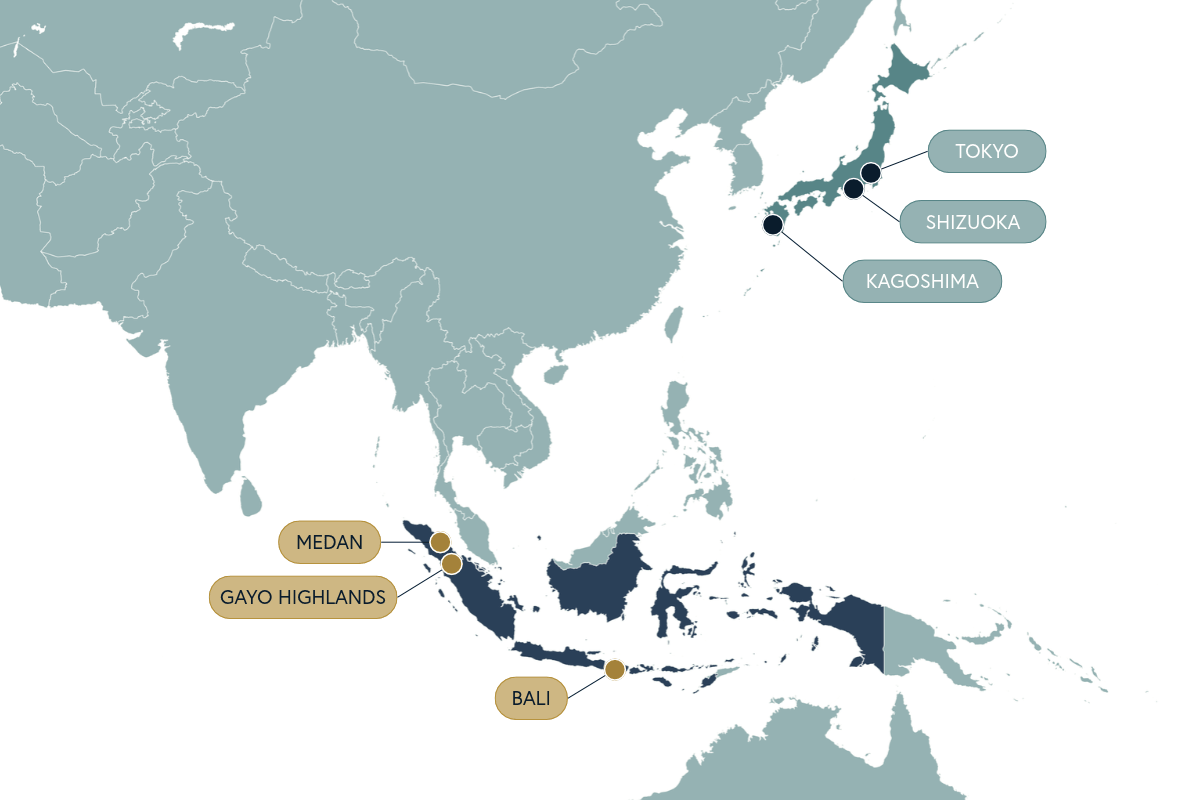
Map outlining RNY’s origin trip, highlighting places they visited in Japan and Indonesia
Kagoshima is located on the southern island of Kyushu. The flight from Tokyo took less than two hours, although the region is also accessible by bullet train in about seven hours.
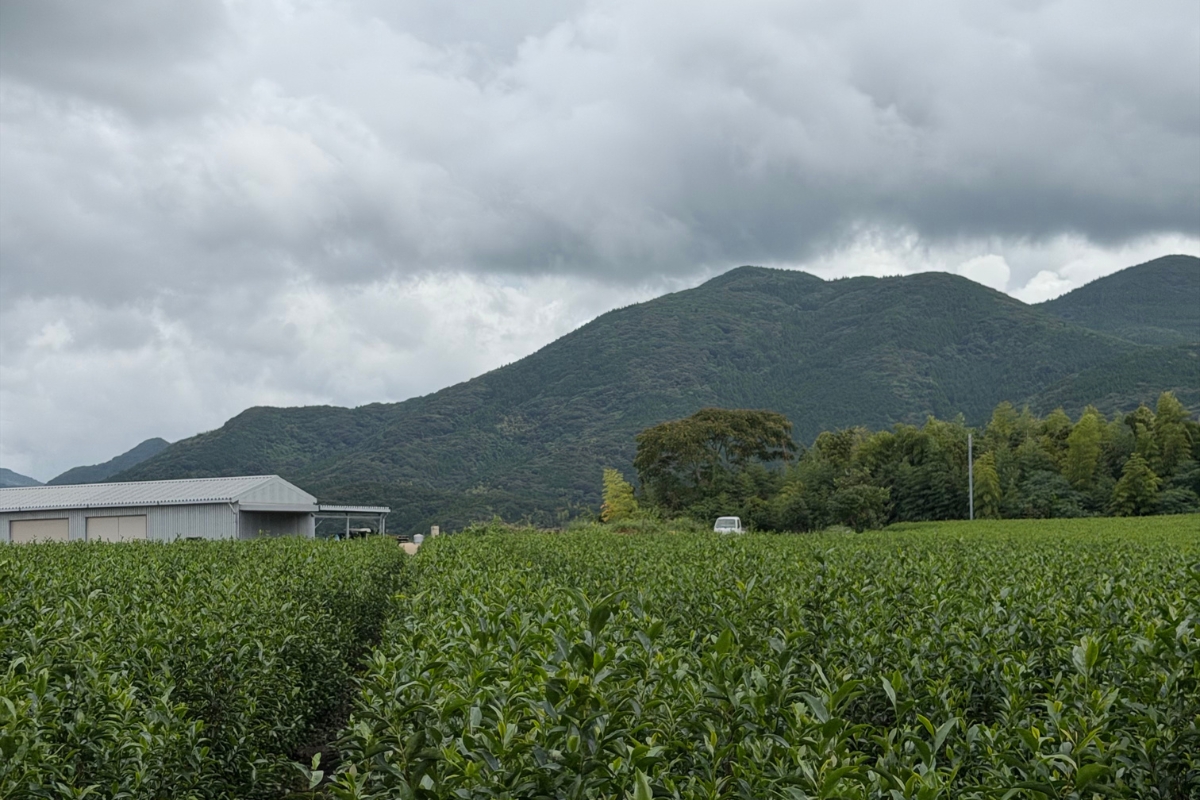
Kagoshima has a subtropical climate and felt much balmier than Shizuoka. Mount Sakurajima, an active volcano, was visible from my hotel room window. Its volcanic soil creates excellent growing conditions for tea and directly shapes the quality and character of Kagoshima-cha.
Visiting Kagoshima Tea Producers
The first day, I was greeted bright and early by our friend Hisae. She’s been the bridge connecting us with producers in this area for years.
There are many winding roads throughout Kagoshima’s mountainsides. Therefore, starting bright and early was a good move! It took quite a bit of time to reach our destinations.
Visiting the Komaki Brothers
We started the day with a visit to the Komaki brothers, Seigo and Shinya. They’re third-generation producers who cultivate both organic and non-organic tea.
Seigo welcomed us warmly and ushered us inside his office. He was eager to show off some samples of sencha and gyokuro, as well as his latest invention: a sencha cube made for instant tea.
He gently placed a cube into a cup and added hot water. Almost instantly, the cube melted, leaving a colorful green brew in its place. The taste was characteristic of steeped loose-leaf sencha, but perhaps a bit more oceanic, if anything.
Seigo proudly explained that their focus is on making quality tea. Their 2019 Prix d’Or at the Japanese Tea Selection Paris, awarded for their Saemidori sencha, is testament to that fact.
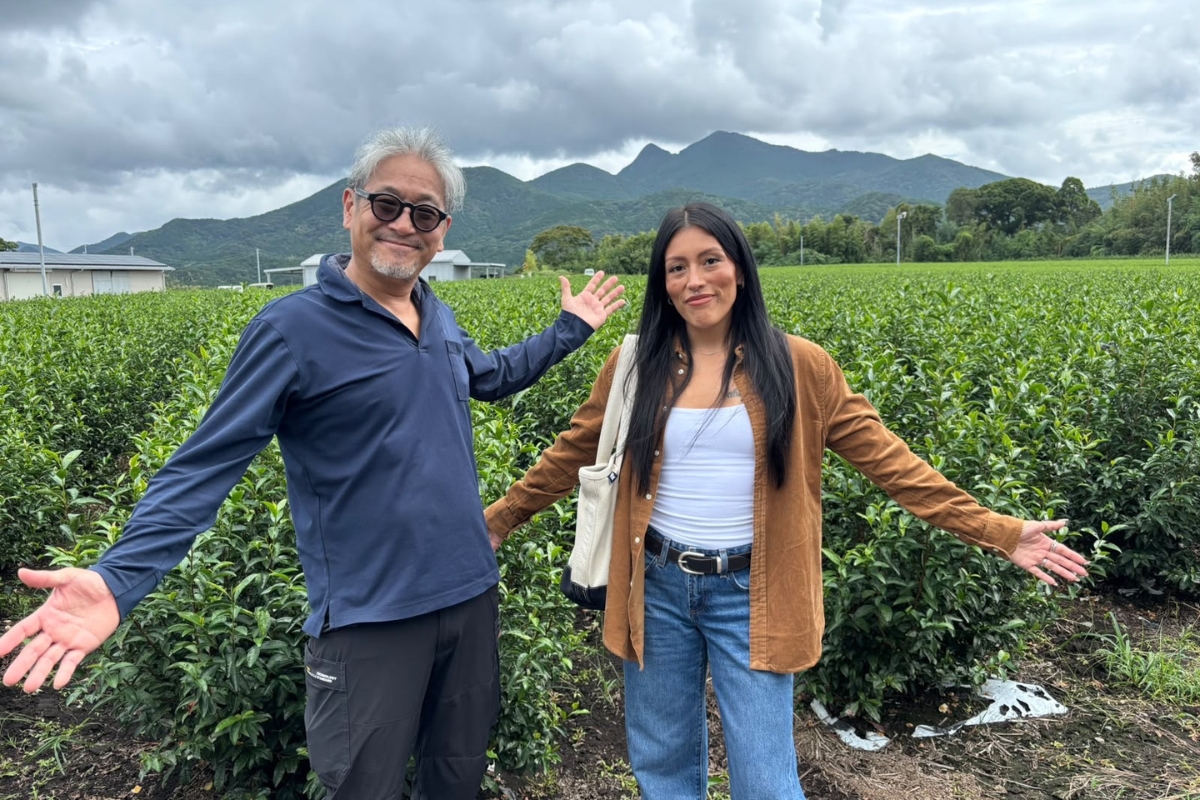
Seigo-san and Caitlin at Komaki brothers’ tea field
However, he doesn’t know who will take over the family business when they retire. This is a predicament many Japanese tea farmers face. Shinya has children, but they don’t have a strong interest in tea. Meanwhile, Seigo is unmarried and has no successors. For now, they’ll continue enjoying what they’ve built.
After tasting some teas, we headed outside to look at the rows of tea plants. Their farm spans 12 hectares, with several cultivars growing across the property. These include Saemidori, Yabukita, and Benifuki.
Seigo explained that they use a ride-around picker to harvest the leaves. It’s a large machine that skims over the tops of the plants, collecting the leaves in a giant basket at the back. Afterwards, they take the leaves to their own tea factory for further processing.
Exploring Kasugaen Kawaji Seicha
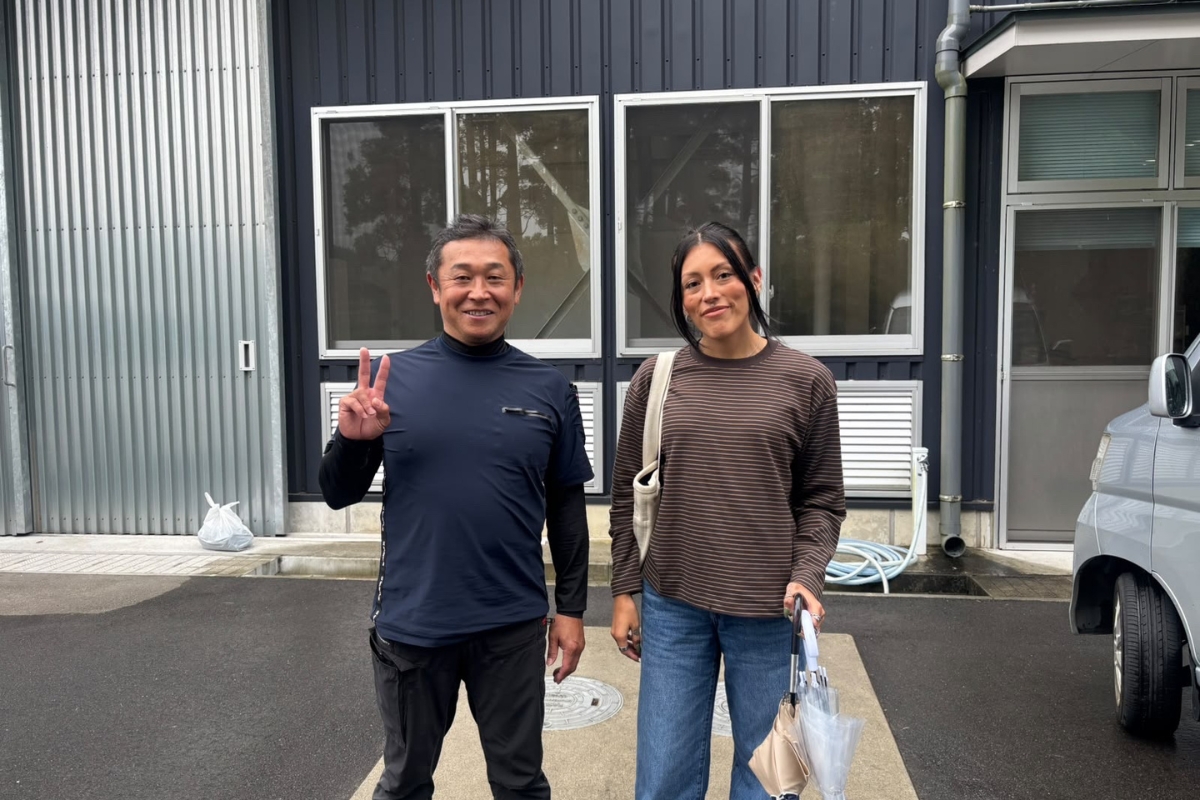
Following our visit with Komaki, we headed north to visit our next producer: Kasugaen Kawaji Seicha. The business is run by a father-and-son duo. Mr. Itaru Kawaji is second-generation, and his oldest son, Kanto, has recently taken on a larger role. It’s something Mr. Kawaji is incredibly proud of.
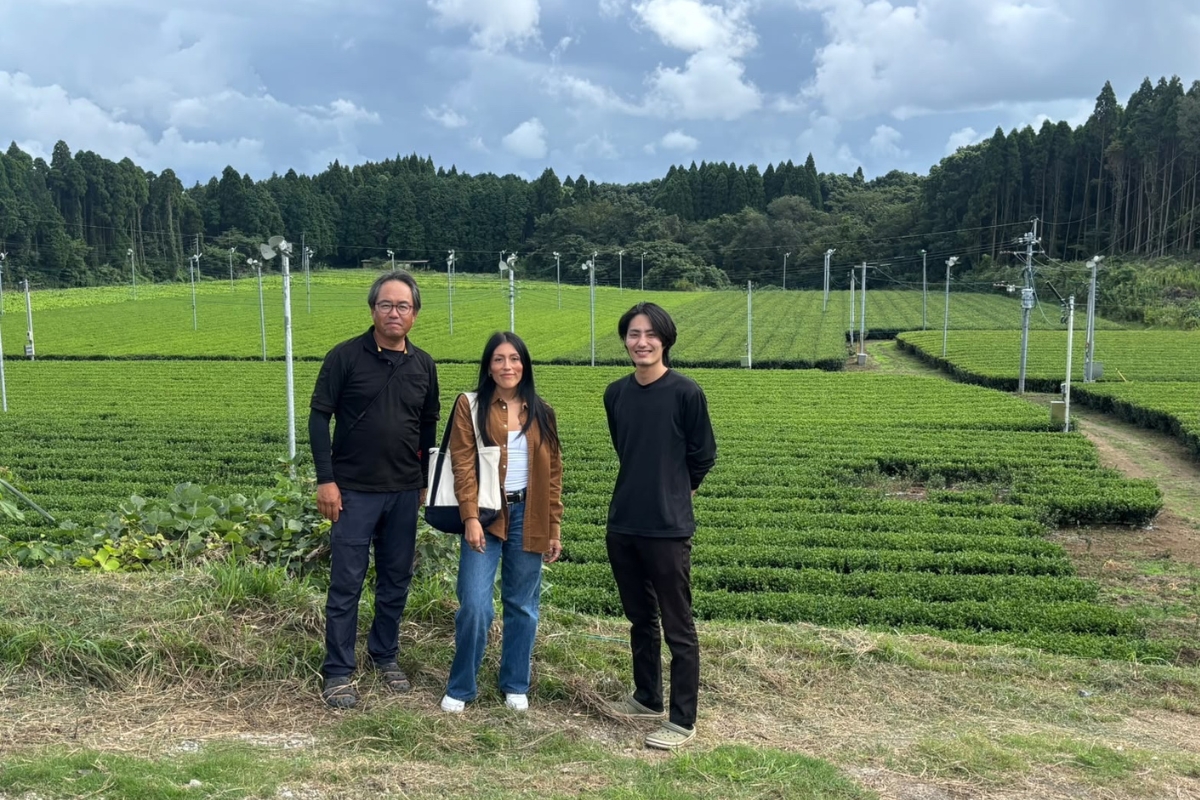
Father-and-son duo, Mr. Itaru Kawaji and Kanto, with Caitlin
Mr. Kawaji produces green tea, but also oolong and black tea. They even produce mulberry leaf, which they grind into a powder similar to matcha. This allows it to be whisked and dissolved.
He gave me some to try, and it was subtly sweet and earthy. There was also a hint of something spice-like on the finish. Best of all, it’s caffeine-free, making it a potential matcha alternative for those who are sensitive to caffeine.
We took a short drive in their company van to visit the tea fields, which sat a little distance from their headquarters. Along the way, he stopped to show me their mulberry fields.
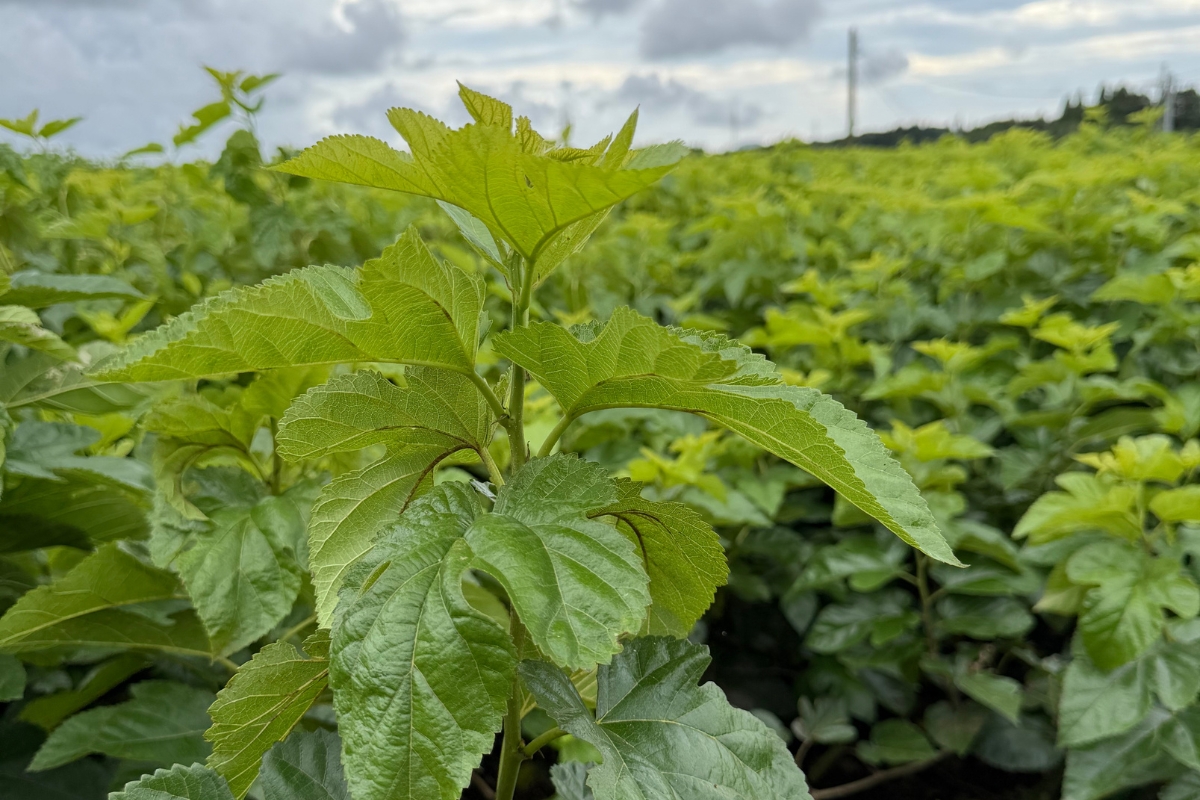
The bushes were a similar height to the tea plants, but their leaves were much larger and wider. Mr. Kawaji owns approximately 10 acres of mulberry plants and a whopping 37 acres of tea plants.
Mulberry leaf plant at Kasugaen Kawaji Seicha
The tea fields were visually striking, peppered with tall fans that push warm air down toward the bushes. We walked up the hillside to get a better view. There, Mr. Kawaji pointed out some of their newer bushes, which were only about a year old.
When we returned to headquarters, we tried a few more teas: a gyokuro from the Asanoka cultivar, oolong, and hojicha. The gyokuro was especially delicious, with a rich umami flavor that was almost broth-like. It also had a subtle sweetness.
A Special Experience with Mr. Shimokobu
The next day, it was time for the final visit of the trip. We were visiting a producer who had come to our office many years ago, before my time at Royal.
Mr. Shimokobu is a third-generation tea farmer. He’s also been producing much of the material that goes into our ceremonial matcha blend, which we’ve purchased for the last eight years.
Mr. Shimokobu and Caitlin
There were many cultivars growing in Mr. Shimokobu’s fields, including Saemidori, Asatsuyu, Okumidori, and Seimei.
His farm sat at approximately 250masl. Strong-looking tea plants of different cultivars stretched across the hillside.
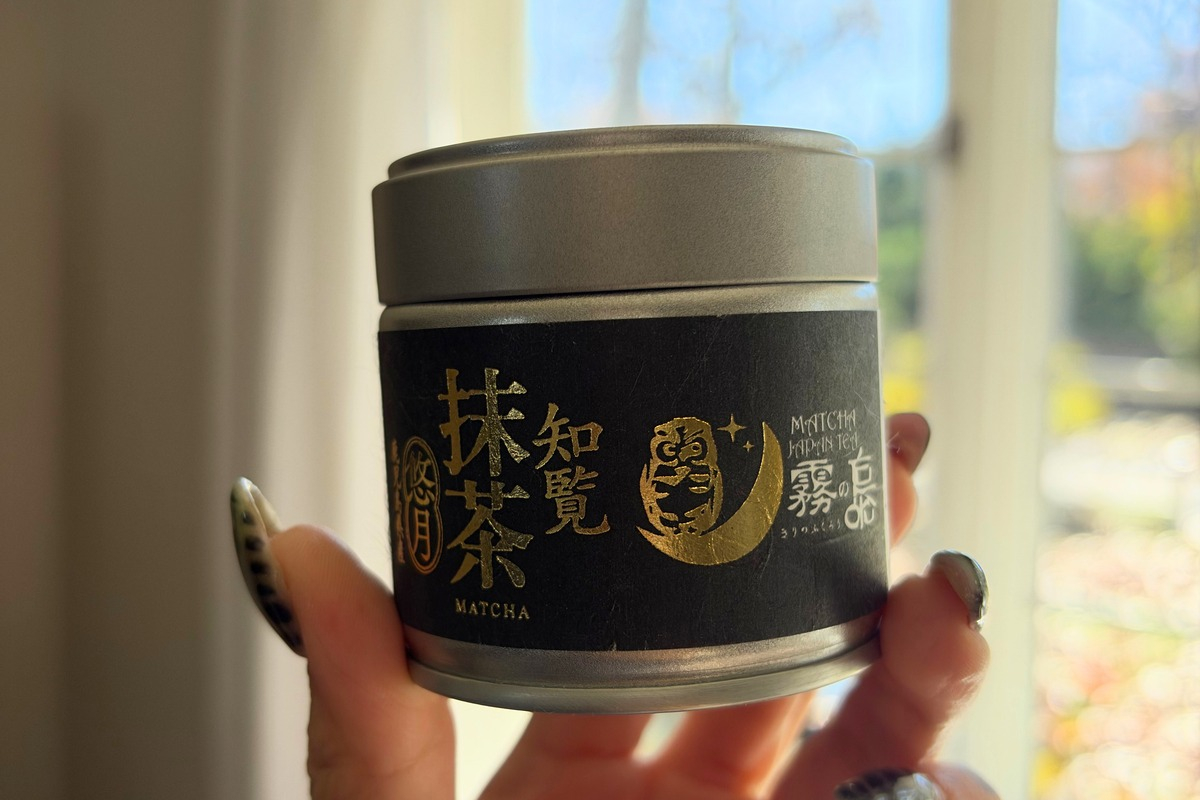
He served us a cup of sencha while excitedly putting together a gift of samples. One of these was a tin of matcha. He said it was an Okumidori matcha, made from first-harvest leaves using a bead mill.
His logo was displayed on the front: an owl perched upon a crescent moon. Naturally, I asked about the design. He explained that the owl symbolizes wisdom and good fortune. In the evening, he said, you can hear owls. While Shimokobu spends the day tending to his tea plants, the owls, moon, and stars watch over his fields at night.
Special matcha tin from Mr. Shimokobu
Dinner with Kagoshima Tea Producers
I wrapped up my time in Kagoshima with a group dinner at a tempura restaurant. Seeing our producer friends out of their work clothes and in more casual wear was a sight to behold. It was also a reminder that, while their tea knowledge is vast (sometimes almost intimidatingly so), they’re still regular people like you and me.
We sat around the counter while the chef served us multiple courses. By the eighth round, I was stuffed! We tried different battered fish, vegetables, and shellfish like shrimp and scallop. We even tried gingko nuts, which aren’t my personal favorite. Luckily, Seigo-san was more than happy to take my share.
After wrapping up the night with some dessert and a final toast, we went our separate ways. The following morning, I flew back to Tokyo before heading home to the United States.
Until Next Time, Kagoshima!
My time in Kagoshima was a wonderful way to wrap up our Japan trip. From meeting the Komaki brothers to visiting the Kawaji and Shimokobu farms, each stop offered a closer look at the people and craftsmanship behind Japanese tea.
It was especially meaningful to see the relationships we’ve built over the years and learn more about the families who continue producing the teas we bring to our customers. Kagoshima has so much to offer, and I’m grateful to have had the opportunity to experience it firsthand.
Thanks for everything, Kagoshima, and see you next time!
Looks like you're not logged in! If you have an account, log in here
Don't have an account? Click here to register or close popup window and continue shopping.
You successfully reset your password, please login to your account.
This site uses cookies to allow for proper checkout and order processing; they are not used for any other tracking purposes. By continuing, you accept our use of cookies.