Looks like you're located outside the continental United States!
While we can't ship Royal NY Line Up boxes to you through our website, our team of coffee traders will be happy to help place your order and secure the best shipping rates for you.
Please note that if you have other items in your cart such as tea or tickets to an event at The lab, you will not be able to proceed to payment until all 22lb. boxes have been removed from your order
Looks like you're located outside the continental United States!
While we can't ship Royal NY Line Up boxes to you through our website, your coffee trader will be happy to help place your order and secure the best shipping rates for you.
Very few things are as ubiquitous, yet misunderstood, as espresso. Ask anyone, and they’ll likely describe it as a concentrated shot of coffee. That’s true, but you’ll hear plenty of other explanations, too.
Some common myths suggest espresso requires a specific type of coffee bean or roast. Others describe it as an incredibly potent shot of caffeine. You might even hear that an espresso shot dies if you don’t drink it within 30 seconds of pulling the shot.
Even within cafes and other sectors of the coffee industry, these myths are often considered fundamental truths. So then, what is espresso, and what makes it different from regular filter-brewed coffee?
By understanding how espresso works, you’ll be better equipped to pull consistent, great-tasting shots. You’ll also gain a deeper appreciation for the science behind this familiar coffee beverage.
What Is Espresso?
Born in the early 20th century in Milan, Italy, espresso has become a pillar of the broader coffee industry. The word ubiquitous isn’t used lightly here. At any given point, wherever you might be, you’re probably not far from a shot being pulled. Whether or not it’s a good shot, we’ll leave to your discretion.
Likewise, the commonly understood definition of espresso is mostly true. Yes, espresso is a concentrated shot of coffee. The issue arises when people begin to extrapolate further. Believe it or not, espresso is just a concentrated shot of coffee, not some completely separate type of coffee beverage.
The first important thing to understand is how an espresso machine works. Specifically, espresso is coffee brewed under approximately 9 bars of pressure. An espresso machine multiplies atmospheric pressure nine times over, typically generating roughly 130 PSI of force at the group head.
Under 9 bars of pressure, the rate at which coffee extracts increases drastically. This results in expressly delivered shots of coffee, hence the name “espresso.”
How Strong Is Espresso Compared to Filter Coffee?
When measured using a refractometer, a well-dialed-in shot measures roughly five to eight times the average strength of filter coffee. A refractometer measures liquid concentration by measuring how light refracts through a sample.
Despite this difference in concentration, both brewing methods generally achieve similar extraction yields. In other words, espresso is five to eight times as concentrated as filter coffee, but the percentage of extracted coffee compounds stays relatively consistent.
Average TDS (Total Dissolved Solids), or the measure of strength provided by a refractometer, ranges between 7% and 12% for an espresso shot. Meanwhile, the average TDS of filter coffee falls closer to 1.3% to 1.5%.
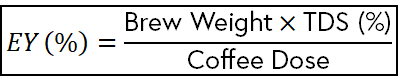
Average extraction yield (EY) usually ranges between 17% and 23%, regardless of whether you’re brewing filter coffee or espresso. We calculate extraction yield using the following equation:
Extraction yield represents the percentage of the coffee bean that dissolves into your brew. On average, only about 30% of a coffee bean is water-soluble. However, achieving a 30% EY would be a herculean task. You’d likely only end up with a jumbled, incredibly intense mess of flavors.
The rate at which flavor compounds extract in coffee is generally consistent. More acidic compounds extract first, followed by sweeter compounds, and lastly, bitter compounds. As a result, you’ll usually find similar kinds of flavors in both filter and espresso brews.
The most significant difference is caffeine, as caffeine extraction is largely a product of brew time. Espresso brews in around 30 seconds, while filter coffee takes far longer. Therefore, espresso generally contains less caffeine than filter-brewed coffee.
What Makes It Behave So Differently?
We’ve established that espresso is essentially regular coffee pulled under approximately 9 bars of pressure. It’s also about five to eight times as concentrated. Why, then, does it look and behave so differently?
The answer is the first part of that definition: pressure.
Why Does Crema Form?
First, we have to talk about crema: that thick foamy top layer of an espresso shot. This layer has become beloved around the world and is frequently considered the mark of great espresso.
Crema is the product of the gasses created during the roasting process, emulsifying and sitting atop your brewed coffee. In other words, the pressure generated during extraction traps these gases. Instead of rising and escaping into the atmosphere, as they would during a filter brew, they pass through the coffee puck and into the shot.
Because crema is an emulsification of gases, it naturally thins as those gases dissipate. This process helps explain the familiar myth that a shot dies if not served within 30 seconds of being pulled. Crema might dissipate, but the espresso shot’s flavor stays the same.
The primary gas created during roasting is carbon dioxide. As a result, crema is mostly made of carbon dioxide, which generally tastes bitter. This contributes to espresso’s intensely bitter reputation.
Crema is particularly lauded for the luxurious, velvety mouthfeel it provides. Whether that mouthfeel should take priority over the taste of a shot remains an intensely debated topic within the coffee industry, so we’ll leave that up to you.
What Is Channeling?
While crema somewhat contributes to bitterness, it primarily affects the mouthfeel of a shot. But what makes espresso taste so intense?
Because espresso is five to eight times as concentrated as regular coffee, mistakes and astringencies become much more noticeable. Not only that, but the significant pressure applied to the coffee puck makes extraction mistakes more likely.
One of the foremost issues when pulling a shot is channeling, a term any espresso aficionado is likely familiar with.
Channeling happens when water takes the path of least resistance through a coffee puck. Under ideal conditions, all water would flow evenly through the puck or bed of coffee. Every ground would receive equal exposure to water, extracting everything as evenly as possible.
However, in practice, water will always take the most efficient route through the coffee bed. This creates channels where surrounding coffee extracts more than the rest of the puck.
As previously stated, compounds tend to extract in the order of acidic, then sweet, then bitter. Therefore, uneven extraction results in some parts of the coffee bed becoming over-extracted, or overly bitter, while other parts remain under-extracted, or overly acidic.
With the concentration of espresso, these variances become particularly pronounced. This can result in incredibly acidic or bitter shots of coffee.
Channeling Isn’t Just in Espresso
This phenomenon isn’t exclusive to espresso, either. Channeling happens in all brews that aren’t primarily infusion-based, such as French press and cold brew.
While channeling is inevitable, our goal with any brew is to minimize it. We want to extract everything as evenly as possible. This is especially important with espresso, where uneven extraction can have a significant impact on the final cup.
Achieving more even extraction starts before pulling the shot. This brings us to another important part of the brewing process: puck preparation, which we’ll cover in an upcoming part two. Stay tuned!
Final Thoughts
Understanding what espresso is and how pressure influences extraction is essential for pulling each shot as intentionally as possible. As with all things in coffee, repetition is the mother of learning. When you pull each shot with intention and understand what’s happening, you’ll quickly find these concepts becoming easier to grasp.
Looks like you're not logged in! If you have an account, log in here
Don't have an account? Click here to register or close popup window and continue shopping.
You successfully reset your password, please login to your account.
This site uses cookies to allow for proper checkout and order processing; they are not used for any other tracking purposes. By continuing, you accept our use of cookies.