Looks like you're located outside the continental United States!
While we can't ship Royal NY Line Up boxes to you through our website, our team of coffee traders will be happy to help place your order and secure the best shipping rates for you.
Please note that if you have other items in your cart such as tea or tickets to an event at The lab, you will not be able to proceed to payment until all 22lb. boxes have been removed from your order
Looks like you're located outside the continental United States!
While we can't ship Royal NY Line Up boxes to you through our website, your coffee trader will be happy to help place your order and secure the best shipping rates for you.
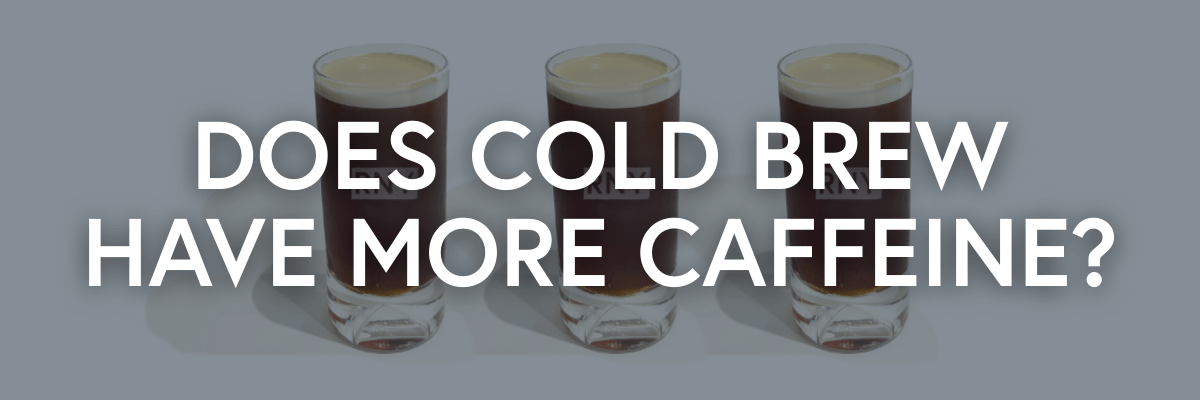
Looking to take your cold brew to the next level? Hot bloom cold brew is a technique that uses a small amount of hot water before the cold steep begins, creating a cup with greater complexity and brightness. Explore the science behind the coffee bloom, how hot blooming affects extraction, and how to try it yourself.
The Cold Brew Craze
We’ve seen many trends come and go in the coffee industry, but few have taken root the way cold brew has over the years. However, with popularity comes market saturation. The cold brew market was valued at $3.87B last year and is projected to reach $24.37B by 2034. This growth speaks to a tremendous rise in demand, suggesting cold brew will remain a staple in the coffee zeitgeist for the foreseeable future.
With cold brew now available on tap and RTD in a growing number of cafés, markets, and convenience stores, it begs the question: how do you make your cold brew stand out?
In previous posts, we’ve touched on various single origins and blends to help differentiate your cold brew. Today, we’re adding another technique to your repertoire: hot bloom cold brew.
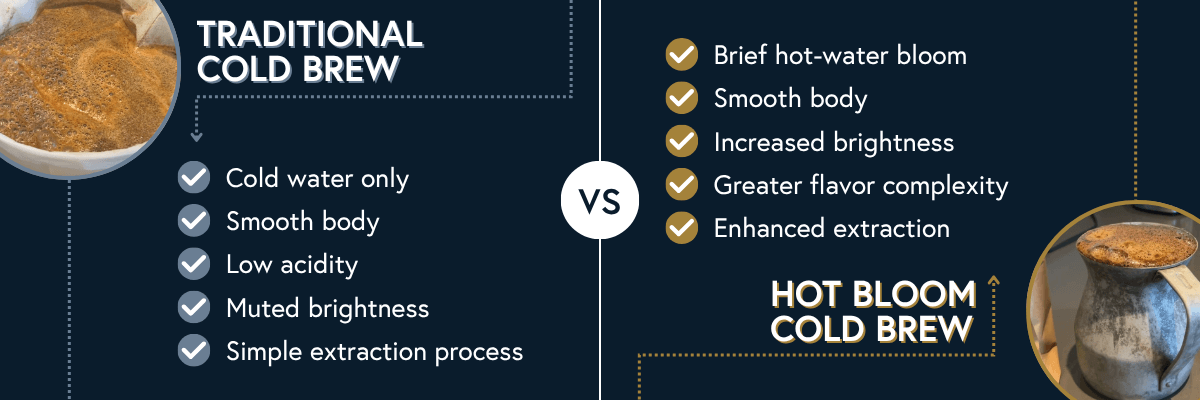
People have been experimenting with coffee brewing for centuries. While the exact origin of hot bloom cold brew isn’t concrete, it began rising to popularity in the early 2010s. Since traditional cold brew isn’t very acidic, hot blooming uses a small amount of hot water before the cold steep to bring out some of the coffee’s natural punchiness and create a brighter overall flavor profile in the final cup.
Understanding the Coffee Bloom
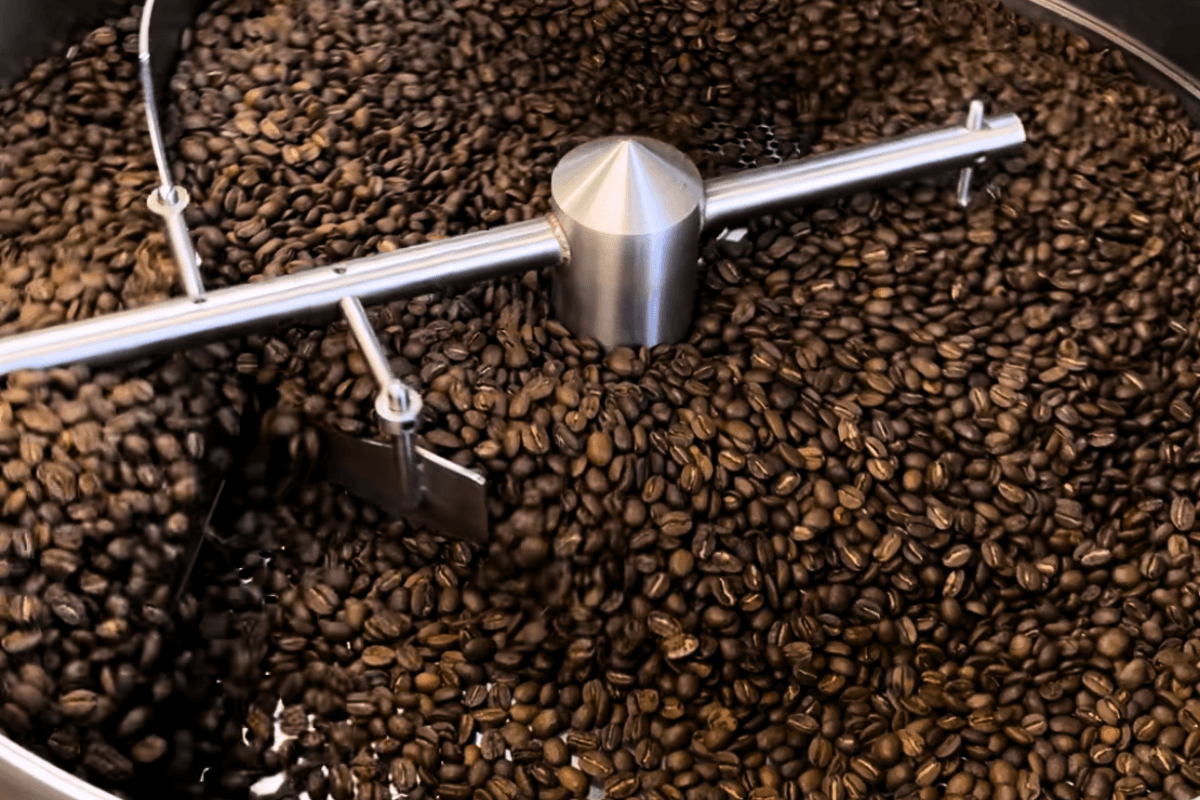
“Bloom” describes the bubbling and fizzing effect that happens when you first pour hot water over coffee. This reaction is caused by the release of carbon dioxide gases that becomes trapped inside coffee during the roasting process.
Think of it like a reverse soda and Mentos experiment. In both cases, CO₂ gathers and forms bubbles. The difference is that coffee doesn’t contain pressurized gas, which is why you don’t end up with a geyser of coffee shooting out of your Chemex.
Why Blooming Matters for Cold Brew
On a microscopic level, the trapped gasses inside the roasted coffee also act as a moisture barrier. When you pour hot water over ground coffee, the CO₂ expands and is released. If the water you’re using isn’t hot, then much of that CO₂ remains trapped inside the coffee and actually acts as a repellant, preventing part of the coffee grounds from making contact with the water.
We’ve already touched on how acidic compounds extract differently in hot water and cold water. Needless to say, a lack of contact between grounds and water is absolutely not the only reason cold brew is naturally less acidic than hot coffee. It does, however, play enough of a part of warrant mentioning.
As with any cold brew method, you can get really granular with brew ratio, steep time, grind size, water temp, etc. Experimenting to determine what works best with your equipment is important to ensure that you’re satisfied with the final product.
Many products can produce hot bloomed cold brew, but you can easily make it with basic brewing equipment. All you need is a kettle, brewing vessel, a brew bag (optional, but extremely helpful), timer, scale, and of course, water and coffee.
Choosing Your Brew Ratio
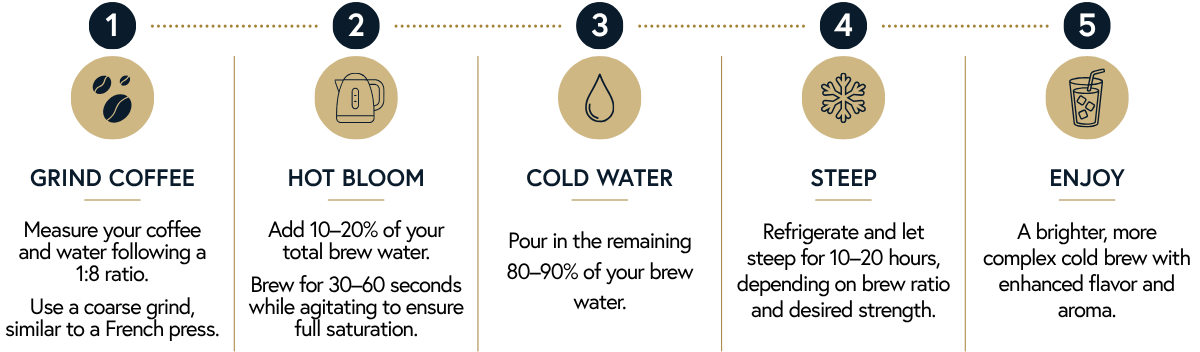
Start by measuring out your coffee and determine your coffee to water ratio in grams. Depending on your overall brew time, you’ll want to use a ratio between 1:6 and 1:8 for ready-to-drink cold brew. Once your coffee is measured, grind it coarse, similar to a French press grind. Pour the grounds into your brewing vessel. If you have a brew bag, you’ll want to line the vessel with the bag first as this will make cleanup significantly easier.
Cold Brew Safety
Make sure your brewing vessel is safe to use with hot water. If you’re brewing in a plastic Toddy, we suggest blooming your coffee in a separate metal or glass pitcher. You can then transfer the coffee to your brewing vessel before adding the remaining water.
Blooming
Pour boiled water evenly over your ground coffee. The bloom stage typically uses 10% to 20% of the total volume of water you plan to use for your brew.
Then, set a timer for 30–60 seconds and agitate the coffee grounds while you wait to ensure they’re completely saturated. Once the hot bloom ends, immediately add your cold water. Refrigerate the mixture and allow it to steep for 12–20 hours, depending on your brew ratio and desired strength.
The final product should be significantly brighter and more dynamic than a traditional cold brew.
Want to try this yourself? Keep reading for some of our favorite coffees for hot bloom cold brew as well as our preferred recipe!
Looks like you're not logged in! If you have an account, log in here
Don't have an account? Click here to register or close popup window and continue shopping.
You successfully reset your password, please login to your account.
This site uses cookies to allow for proper checkout and order processing; they are not used for any other tracking purposes. By continuing, you accept our use of cookies.