Looks like you're located outside the continental United States!
While we can't ship Royal NY Line Up boxes to you through our website, our team of coffee traders will be happy to help place your order and secure the best shipping rates for you.
Please note that if you have other items in your cart such as tea or tickets to an event at The lab, you will not be able to proceed to payment until all 22lb. boxes have been removed from your order
Looks like you're located outside the continental United States!
While we can't ship Royal NY Line Up boxes to you through our website, your coffee trader will be happy to help place your order and secure the best shipping rates for you.
Over the past decade, the word “mycotoxin” has gone from an obscure agricultural term to a hot topic, especially among wellness brands promoting “mold-free” products. As importers, we’re asked about mycotoxin testing for green coffee almost daily, and while the concern is understandable, the reality is often far less alarming than it sounds. Let’s break down what mycotoxins actually are, how they relate to coffee, and what—if anything—you need to worry about.
What Are Mycotoxins?
Mycotoxins are harmful byproducts of certain fungi that are found in many agricultural products, including coffee. The FDA estimates that about 25% of the world’s crops contain mycotoxins, though most do not contain harmful levels.
There are over 185 unique types of mycotoxins, but in coffee, there are only two specific types: aflatoxin B1 and ochratoxin A. Both are produced by a fungi of the genus Aspergillus, which is primarily found in rotting organic matter.
Because coffee undergoes fermentation, a controlled rot process is essential for production and unavoidable. However, the practices that produce great coffee are the same ones that inhibit mold growth.
Why Specialty Coffee Has Lower Risk of Mycotoxins
The practices that create a great tasting cup of coffee also prevent the fungi growth that leads to mycotoxin development. Farmers, millers, exporters, and importers are all acutely aware of the health risks posed by mold.
To reduce the risk of fungi cropping up, there are quality control processes in place throughout the seed to cup journey:
Defective, moldy lots are rejected early
Proper processing standards are enforced
Storage conditions are closely monitored
We’re lucky in the specialty coffee industry: the terms “high quality” and “moldy” are generally mutually exclusive. As long as we’re diligent about practicing food safety, the risks are extremely low.
Preventing Mycotoxins in Coffee
Since healthy coffee cherries are inherently juicy and require fermentation, coffee is extremely susceptible to mycotoxin development. Mycotoxin prevention is all about controlling conditions that allow fungi to grow. In coffee, this happens at two key stages: production and storage.
Drying and Processing at Origin
Improper drying is the number one cause of mold growth in coffee.
To prevent this:
Coffee cherries are regularly turned to promote even drying
pH levels are routinely tested
Foreign contaminants are kept far away from drying patios
Moisture content is reduced to 10-11% (max 13%)
Mold loves warm, damp environments, so it’s critical that preventative measures start at origin through proper drying practices.
Proper Green Coffee Storage
Once dried, mycotoxin prevention is all about proper storage. Changes in temperature or humidity not only impact green coffee shelf-life, but increase risk of mold growth.
Key coffee storage practices include:
Keeping coffee off the ground
Using climate-controlled environments
Avoiding temperature swings and humidity fluctuations
Storing away from HVAC units to prevent condensation
It’s important to create an environment that is inhospitable to fungi. Even small climate changes can create conditions for mold growth if not managed properly.
Does Roasting Remove Mycotoxins in Coffee?
Roasting will kill the majority of molds that produce mycotoxins, but not the mycotoxins themselves.
Mycotoxins are hardy and heat-resistant, which means:
You can’t rely on roasting to eliminate them
Controlling risk earlier in the supply chain is essential
Proper processing and storage are the most important safeguards, so prevention is really the name of the game.
Are Mycotoxins in Coffee Dangerous?
In high concentrations, mycotoxins can cause health problems ranging from mild flu-like symptoms to more serious long-term effects. But that risk depends entirely on dose and exposure over time.
Understanding Tolerance Levels
It’s probably a little uncomfortable to think about any “toxin” being in your coffee. That being said, it’s important to consider your body’s tolerance for mycotoxins.
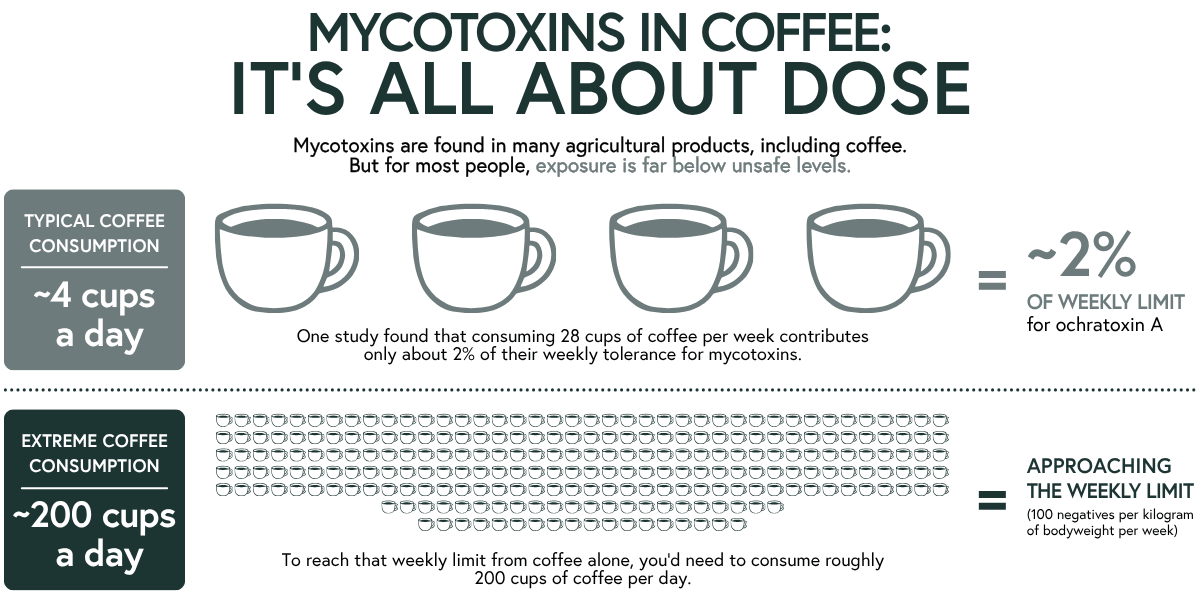
The World Health Organization has set the average person’s Provisional Tolerable Weekly Intake (PTWI) for byproducts like mycotoxins at “100 negatives per kilogram of bodyweight per week.” In practical terms:
One study found that consuming 28 cups of coffee per week (about 4 per day) contributes only about 2% of their weekly tolerance for mycotoxins.
To reach that weekly limit from coffee alone, you’d need to consume roughly 200 cups of coffee per day.
Think of it like bananas, which naturally contain trace amounts of radioactive potassium (K-40). It’s technically present, but not dangerous unless consumed in extreme, unrealistic quantities (about 40 million bananas over 30 days, to be exact).
While maxing out your PTWI with 200 cups of coffee per day doesn’t account for mycotoxins consumed from other agricultural products, it does illustrate that you’d have bigger issues to deal with if you managed to drink that much coffee.
Should You Test for Mycotoxins?
Standard quality control practice already minimize mycotoxin risk to extremely low levels.
That said:
Lab testing is available if you want to send your coffee samples for mycotoxin analysis
“Mold-free” certifications may appeal to new customer segments
Some may be more sensitive to mycotoxins and prefer verified products
Final Thoughts
Mycotoxins aren’t new. They’ve existed for much of human history and will remain as long as we continue to grow and store food. Thankfully, most healthy adults are well-equipped to handle mycotoxins (and worse).
The bottom line: as long as you’re responsibly sourcing high-quality coffee and following proper storage techniques, you’re already doing everything necessary to keep mycotoxins at bay.
Looks like you're not logged in! If you have an account, log in here
Don't have an account? Click here to register or close popup window and continue shopping.
You successfully reset your password, please login to your account.
This site uses cookies to allow for proper checkout and order processing; they are not used for any other tracking purposes. By continuing, you accept our use of cookies.