Looks like you're located outside the continental United States!
While we can't ship Royal NY Line Up boxes to you through our website, our team of coffee traders will be happy to help place your order and secure the best shipping rates for you.
Please note that if you have other items in your cart such as tea or tickets to an event at The lab, you will not be able to proceed to payment until all 22lb. boxes have been removed from your order
Looks like you're located outside the continental United States!
While we can't ship Royal NY Line Up boxes to you through our website, your coffee trader will be happy to help place your order and secure the best shipping rates for you.
Many roasters have recently been asking, “Where have all the Indos gone?” Indonesia is a core origin for a lot of coffee roasters, but it’s not behaving like an abundant one right now. Learn what’s happening at origin, what roasters should expect, and how to move forward.
What happened to coffee from Indonesia?
If you’ve been buying Indonesian coffee for a while, then you’ve probably noticed a shift. The market is the tightest it’s been in years, and only just beginning to show signs of loosening. Between stronger domestic consumption and the impact of last November’s cyclone, exportable supply has been squeezed dry.
For roasters, this shifts their approach to menu building. Indonesia isn’t really a “buy it when you need it” origin anymore—it’s becoming one you need to plan for.
What’s impacting the Indonesia coffee supply chain?
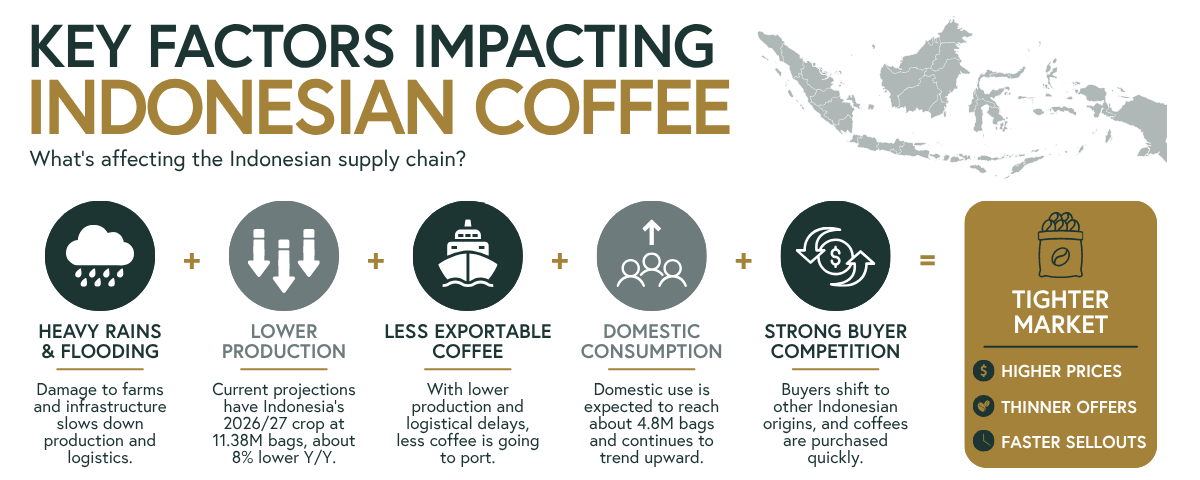
Much of the immediate pressure is due to weather events. Heavy rainfall and flooding in Sumatra continue to effect real damage to farms and infrastructure (roads, bridges, warehouses, and mills), especially in Aceh and North Sumatra. Not only does this affect production, it also slows down the entire supply chain, including how quickly coffee can make its way to port.
Then, as Sumatra production tightened, buyers shifted to sourcing from other Indonesian origins with similar profiles. Coffees from Java, Flores, and Sulawesi were picked up fast, and in many cases, seemed to disappear practically overnight.
Indonesia is also consuming more of its own coffee. Domestic use is expected to reach about 4.8 million bags and continues to trend upward. On its own, that’s a manageable figure. Combined with lower production and logistical challenges, however, it quickly compounds export pressures.
As we look ahead, production is anticipated to be down. Current projections have Indonesia’s 2026/27 crop at 11.38 million bags, which is about 8% lower Y/Y. Robusta will likely see the biggest drop, which matters for anyone relying on Indonesia coffee for blend structure, body, or cost control.
What does this mean for roasters?
All of these issues are now affecting the market. Prices are holding firm, offers are thinner, and waiting rarely works in your favor. When you add transit times stretching 60–90 days from contract to arrival, it becomes difficult to rely on spot buying.
Because of this, we’re seeing more forward coverage, especially on coffees roasters know they’ll need. Offerings like staple blend components and dependable lots are being locked in earlier.
When supply outweighs demand, a shorter buying window can work. However, in a market like this, it can leave you exposed. You may end up paying later, dealing with limited options, or ordering a coffee that wasn’t your first choice.
How should roasters move forward?
This isn’t about panic buying—it’s about planning more strategically.
If Indonesia coffee plays an important role in your program, then it’s worth getting head of your needs. Lock in the volumes you know you’ll use, be clear on what’s essential versus flexible, and look for areas where you can create some breathing room. Even small adjustments across origins or profiles can reduce pressure without changing the cup too much.
Coffees from other key regions in Indonesia (Bali, Sulawesi, Flores, and Java) are shipping June–August, but those arrivals will likely move fast given the ongoing tightness and existing demand. To help avoid gaps down the line, take a look at your current needs and work with your trader to contract early. If you’re looking for a place to start the conversation, click the origin tabs to check out some of our upcoming coffee arrivals from Indonesia!
Sumatra
Bali
Java
Sulawesi
Flores
Final Thoughts
Indonesia coffee is there—it’s just not as easily available or predictable as before. There’s some expectation that availability could improve between late July–early October, but that’s still a bit away.
For now, staying ahead of your needs, planning a bit further out, and maintaining strong communication with your trader will have the biggest impact on your sourcing strategies.
Looks like you're not logged in! If you have an account, log in here
Don't have an account? Click here to register or close popup window and continue shopping.
You successfully reset your password, please login to your account.
This site uses cookies to allow for proper checkout and order processing; they are not used for any other tracking purposes. By continuing, you accept our use of cookies.