Looks like you're located outside the continental United States!
While we can't ship Royal NY Line Up boxes to you through our website, our team of coffee traders will be happy to help place your order and secure the best shipping rates for you.
Please note that if you have other items in your cart such as tea or tickets to an event at The lab, you will not be able to proceed to payment until all 22lb. boxes have been removed from your order
Looks like you're located outside the continental United States!
While we can't ship Royal NY Line Up boxes to you through our website, your coffee trader will be happy to help place your order and secure the best shipping rates for you.
Since its launch, the Coffee Value Assessment form has created a lot of buzz in the industry. The grading format is a major shift from the SCA ’04 scorecard, and there are still plenty of questions on how to use it for day-to-day buying. After revisiting the form and completing the CVA certification course, Mike Ward gained a clearer understanding of how the SCA CVA form can help identify the right coffee for your green buying needs.
What Is the CVA Form?
The goal of the Coffee Value Assessment form is to help you identify what coffee works best for you. At a glance, it appears similar to the ’04 card, as you are still grading fragrance, aroma, flavor, etc. But there’s a catch: the numerical scores are actually based on how well that particular sample suits your needs.
For example: You’re looking for a bright/sweet Honduran coffee to add acidity to your blend, and you have four samples to choose from.
First: mild, but pleasant, acidity with okay sweetness
Second: sharp, unstructured acidity but has great sweetness and balance
Third: sparkling acidity with good structure, nice sweetness but an unremarkable flavor profile
Fourth: another mid-range with an unnoteworthy profile
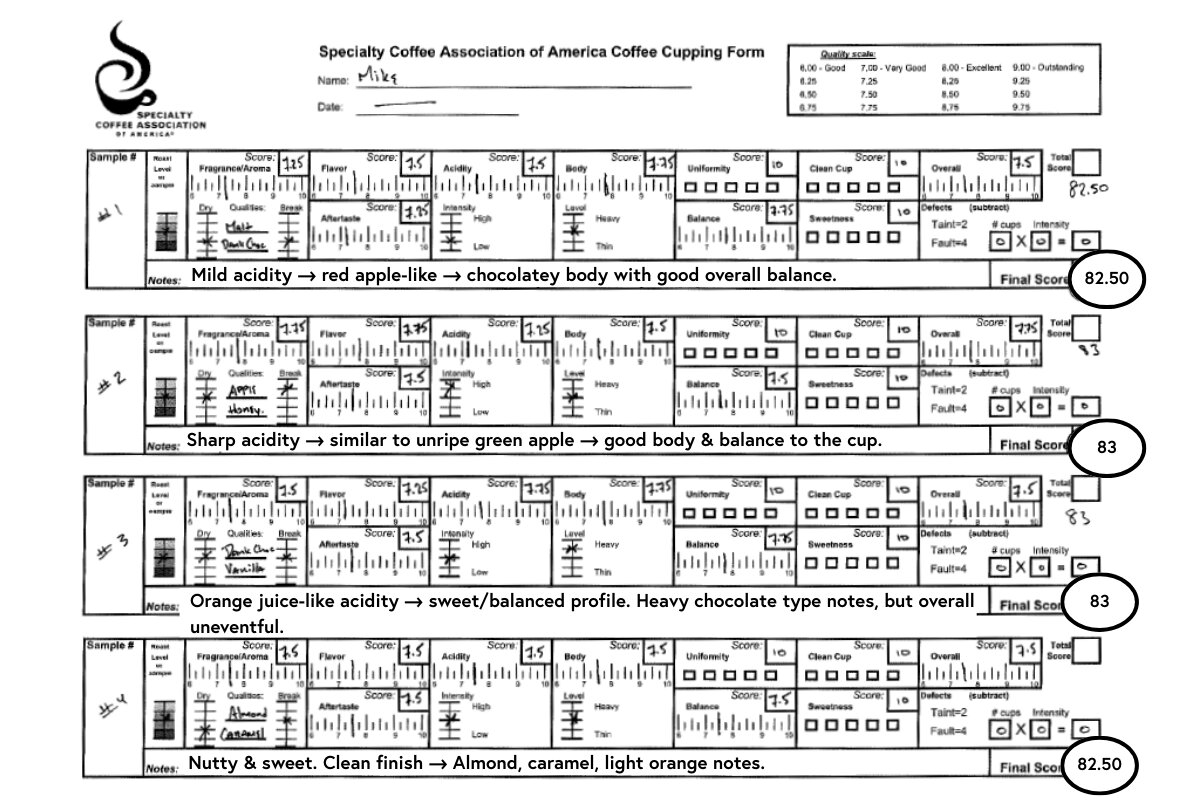
Looking at these coffees with the ’04 scorecard, you could end up with scores that are about the same. Each coffee has a redeeming quality, so each one could achieve 82-83 points for different reasons.
The SCA CVA form works differently. The new card objectively looks at the purpose of your cupping and asks you to score based on that instead of those redeeming qualities. Therefore, those scores could range from 58 to 100, clearly identifying which coffee works best for your needs.
What’s on the New SCA Form?
The CVA includes new “outside the cup” detail sheets designed to add important context to each coffee and help determine whether it actually fits your intended purposes. These additions are the Extrinsic Form and the Physical Form.
However, the numerical grading forms are where the CVA really begins to differ from the ’04 card. The Descriptive Form and Affective Form are where you’ll evaluate a coffee’s profile and, more importantly, how well it works for you. As mentioned earlier, scores can look very different here and will, theoretically, help clarify whether a coffee is what you’re looking for. Let’s break down each form and see what they’re for.
Extrinsic Form
On the Extrinsic Form, you assess how traceable the coffee is and paint a more in-depth picture of the sample in front of you. The form includes fields for Farming, Processing, Trading, Certifications, and “Other,” each with space for notes. While this information does not impact the final score, it serves as documentation you can reference when deciding if the sample fits your needs.
For example, say you’re sourcing a blend component. You probably don’t need a coffee with a lot of information. You just need to know that it’s a washed processed sample from that’s an SHG grade. Additional information can be helpful, but it’s not always essential unless you plan to communicate those details to customers. On the other hand, when selecting a single origin lot to highlight, the more information you have, the better.
Physical Form
This form will feel familiar to anyone who has completed the CQI Q program. Here, you evaluate the physical green coffee by noting color, moisture content, and sample size, then by identifying and tallying and defects. At RNY, we routinely sort through samples and maintain quality standards through our supplier contracts, so this form is less critical when working with us, but may be useful when buying direct elsewhere.
Descriptive Form
This form essentially reimagines the intensity sliders from the ’04 scorecard. Rather than assigning numerical values, you’re simply noting how intense each category is. These sliders aren’t meant to grade quality, but to describe the coffee’s profile. You’ll also see some new descriptor fields to replace the cupper’s open-ended notes section. These standardized terms provide additional context around what you’re grading a coffee a certain way.
Following the example from earlier, we’ll act like we’re still searching for a Honduran coffee to be used in a blend:
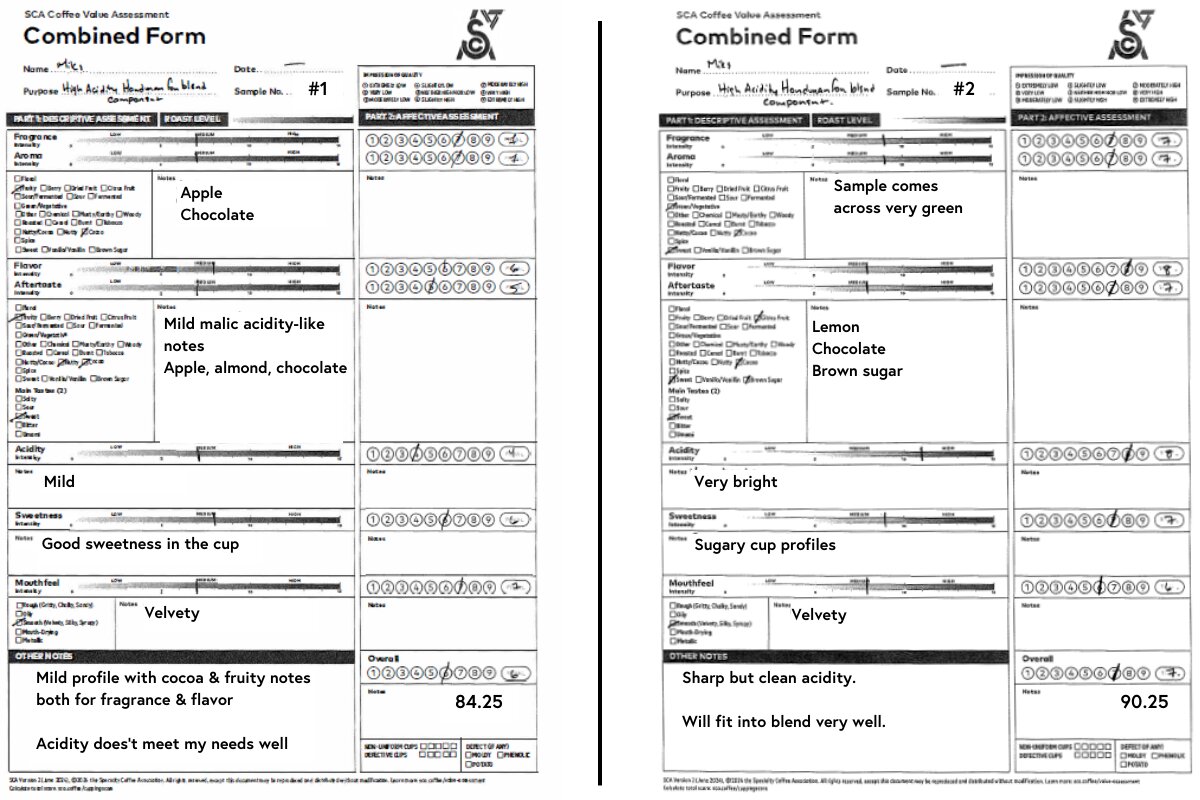
This sample was a straight up washed mild profile. The dry fragrance and wet aroma had notes of sugar browning and mild fruit. It wasn’t very intense for these, so I marked it in the medium category. The flavors found in the cup fell right in line with the dry and wet aromatics. Pretty unexceptional washed mild with mid-range acidity, with notes of almond, chocolate, and a touch of apple. Overall, the flavor, aftertaste, acidity, sweetness, and mouthfeel were just about the same, with most sliders sitting in the medium range.
In addition to marking intensity for each, you also need to select the relevant descriptors. Here, I marked fruity and cocoa for the fragrance/aroma and fruity, nutty, and cocoa for the flavor/aftertaste. Mouthfeel was velvety, so I checked smooth as the descriptor.
That’s it for this form—pretty straightforward and still closely aligned with the ’04 card. Now, onto something completely new: the Affective Form.
Affective Form
This is where the actual grading happens, as well as where your numbers can get pretty crazy pretty quickly if you’re using the form correctly. Initially, I thought I could approach this just like I would the traditional grading system, but after taking the CVA for Cuppers course, I learned differently. Here, this score is purely dependent on how well a coffee fits the purpose for your cupping.
Using the same example, I’m looking for a Honduran with bright acidity for a blend component. We’ll use the same set of samples described earlier as well:
Sample #1
Fragrance/ Aroma: Mild but pleasant acidity with okay sweetness.
Fragrance and Aroma fit what I need. Chocolate and some fruit notes work well, so I’ll score this on the higher end and give both of those a 7 (out of 9).
Flavor/Aftertaste are okay, but a little too almond-forward for what I’m looking for, so I’ll score Flavor a 6. The Aftertaste stayed consistent with that almond tone, which I don’t want, so I’ll scored it a 5.
Acidity, which is my primary need, fell flat, with more of a malic note than citrus tones. Because of that, I scored it a 4.
Sweetness was good with a nice chocolate and baked apple-type tone to it. It seems to fit okay, so I scored it with a 6.
Mouthfeel was velvety because of that milk chocolate note, which would fit into the blend, so I scored it a 7.
Overall, the coffee was nice, but for the purpose of this cupping, it left something to be desired, so I scored it a 6.
Using the CVA calculator, the result on paper seems good at an 84.25. Now, if we were using the ’04 card, an 84.25 would be a solid blend component with some really nice notes. With the CVA score though, it all depends on how it stacks up against others on the table and what fits best.
Why Use the CVA Form?
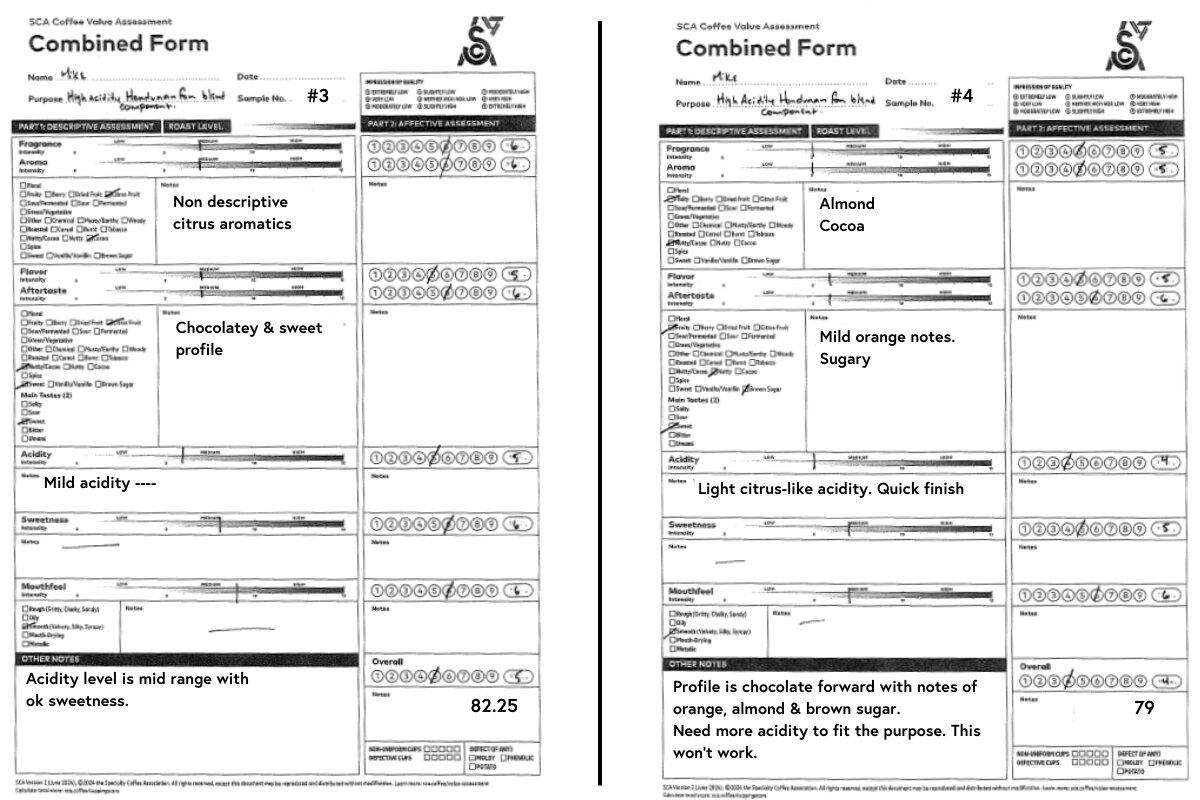
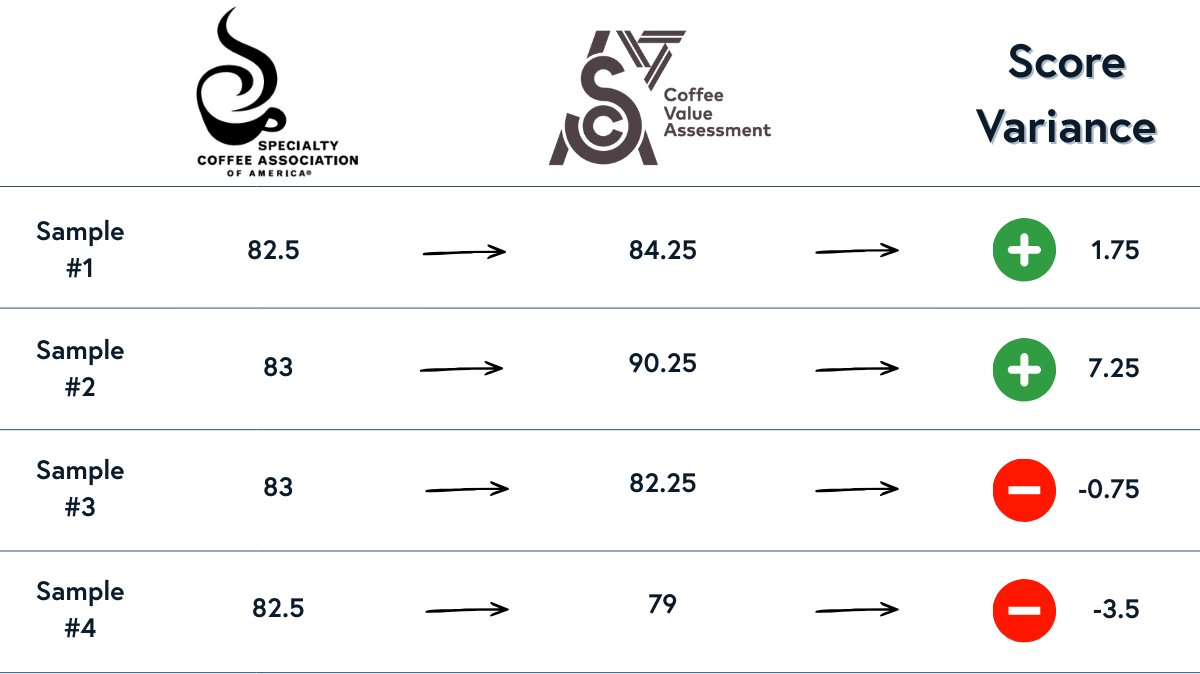
These four samples show why the SCA CVA form is so different, score-wise. The CVA scores are pretty wild to look at compared to those from the ’04 scorecard, especially regarding Sample #2. Why are they so different? Well, the acidity was more intense in #2. While it lacked some structure, it fit the purpose. That’s what the new sheet is hoping to provide you with. The traditional form said it was a pretty good coffee, but since the new form found it to be exactly what I needed, the score rewarded it.
The argument could honestly be made for both sheets. While the new SCA CVA form won’t replace the ’04 card overnight, it is a valuable tool for targeted buying.
Looks like you're not logged in! If you have an account, log in here
Don't have an account? Click here to register or close popup window and continue shopping.
You successfully reset your password, please login to your account.
This site uses cookies to allow for proper checkout and order processing; they are not used for any other tracking purposes. By continuing, you accept our use of cookies.