When it comes to roasting coffee, data isn’t just numbers—it’s how heat interacts with the bean. One of the most powerful metrics a roaster can use? Rate of rise. Learn how you can use rate of rise to understand and control your roast.
What is Rate of Rise?
Rate of rise, or RoR, is a measure of momentum. RoR shows how quickly bean temperature increase, usually expressed in degrees per minute (°F or °C/min). For example: if your bean temperature is 300°F and one minute later is 315°F, your RoR is 15°F per minute. Learning to read, manage, and adjust this metric is key to developing flavor, improving consistency, and elevating your roasting skills.
Why Rate of Rise Matters
RoR helps you anticipate what’s coming, not just react to what’s happening. Here’s why it’s so crucial:
Flavor Development
A controlled RoR affects how sugars caramelize and acids develop. Uncontrolled spikes or crashes can lead to baked, underdeveloped, or uneven flavors.
Consistency
By aiming for repeatable RoR curves, you can produce the same flavor profile roast after roast.
Feedback
RoR tells you how your machine is transferring heat in real time, allowing you to make precise gas or airflow adjustments.
Decision Making
Understanding where your RoR is trending helps you plan for turning point, first crack, and development time more accurately.
Typical RoR Curve Behavior
A well-executed roast follows a controlled declining RoR curve, often described as a smooth, downward trajectory without spikes or crashed. How your roast turns out depends on how your RoR is managed while your roast.
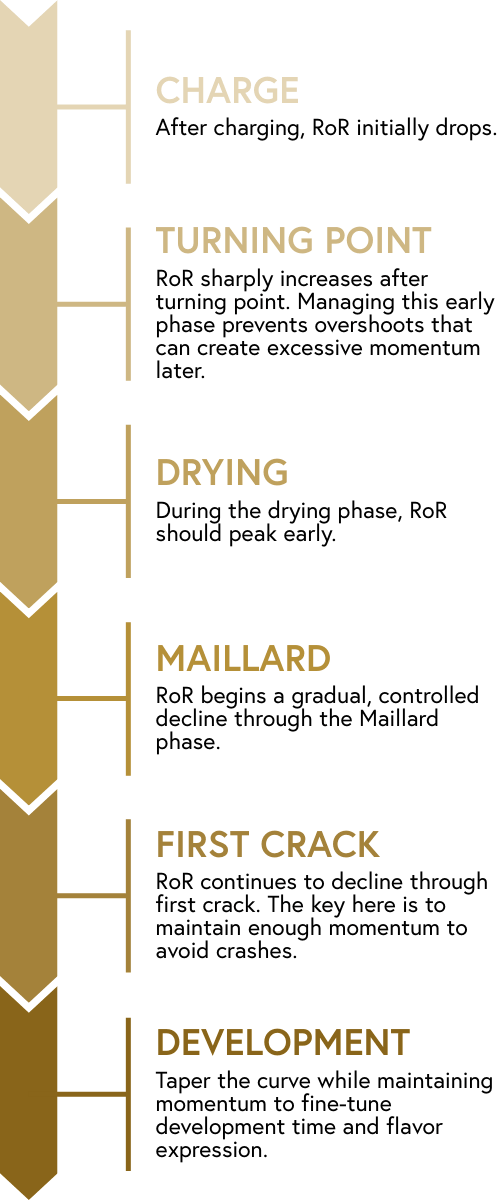
Charge → Turning Point
After charging, RoR initially drops, then sharply increases following turning point. Managing this early phase prevents overshoots that can create excessive momentum later.
Drying → Maillard
RoR should peak early and begin a gradual, controlled decline through the Maillard phase.
First Crack → Development
RoR continues to decline through first crack. The key here is maintaining enough momentum to avoid crashes while tapering the curve to fine-tune development time and flavor expression.
Common Rate of Rise Issues
Spike
Often occurs when too much heat is applied, which can lead to rapid acceleration, shorter Maillard, and potential scorching.
Crash
A sudden drop, often due to aggressive heat reduction, can stall development and result in baked flavors.
Flat
Indicates the roast has lost momentum, which can impact clarity and complexity.
Final Thoughts
Understanding and controlling rate of rise transforms roasting from reactive into predictive. By focusing on RoR, roasters can ensure greater consistency, troubleshoot more effectively, and craft roast curves that align with their flavor objectives.